Key facts
- Astronomers using NASA's Chandra X-ray Observatory identified a hidden companion object that strips material from the massive star AT 2016blu every 113 days as the pair orbits.
- AT 2016blu is a luminous blue variable, a hot, massive star characterized by changes in brightness.
- The brightness spikes from AT 2016blu resemble supernova explosions, but the star survives, so astronomers call it a supernova impostor.
- From 2012 through 2026, astronomers recorded no fewer than 27 optical outbursts from AT 2016blu at intervals of about 113 days.
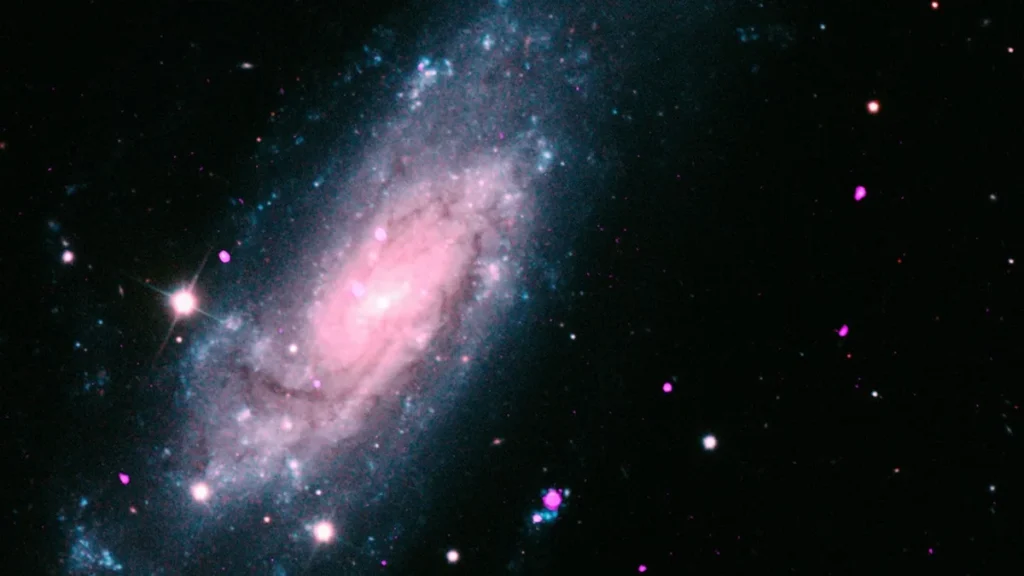
Astronomers using NASA’s Chandra X-ray Observatory identified a hidden companion object orbiting the massive star AT 2016blu every 113 days. Located in the spiral galaxy NGC 4559, AT 2016blu is about 30 million light-years from Earth. The object strips material from the star every 113 days as the pair orbits. This marks the first X-ray detection of an erupting star in this class and the first one found with a companion that is a black hole or neutron star.
The hidden object is either a stellar-mass black hole or a neutron star, which is a dense core left when a massive star collapses. At the closest point in its oval orbit, the compact object captures material thrown off by the star. That captured gas travels at nearly light speed, heats up, and shines brightly in X-rays. This process explains the extreme X-ray brightening seen in March 2026 compared with 2001 to 2002.
Based on its X-ray brightness, AT 2016blu qualifies as a candidate ultra-luminous X-ray source (rare, bright X-ray sources; some contain neutron stars, others black holes). In March 2026, X-ray measurements showed AT 2016blu at least 100 times brighter than in Chandra observations from 2001 through 2002, before the start of the outbursts. The 2001 through 2002 observations predate the outbursts recorded from 2012 through 2026.
From 2012 through 2026, astronomers recorded no fewer than 27 optical outbursts from AT 2016blu at intervals of about 113 days. The star is a luminous blue variable, a hot massive body with changes in brightness, and its mass is at least 33 times that of the Sun. Its brightness spikes resemble supernova explosions, but the star survives, so astronomers call it a supernova impostor. “For 15 years, astronomers have been watching this star get really bright and then dim again on a regular basis,” said Mojgan Aghakhanloo of the University of Virginia in Charlottesville, who led the study.
Núria Torres-Albà, a University of Virginia co-author, said the star confused astronomers because it acts like a supernova yet survives outbursts about three times a year. She said the team needed X-ray data timed to an outburst to understand the cause of the eruptions. Nathan Smith, a University of Arizona co-author in Tucson, suggested periodic high-energy X-ray blasts could power the repeating optical flashes.
No other X-ray telescope matched Chandra’s sharp vision for telling AT 2016blu apart from another nearby bright X-ray source, so the team chose Chandra. That separation was necessary to isolate the star’s X-ray emission from the nearby source.
Optical monitoring drew on the Katzman Automatic Imaging Telescope, the Las Cumbres Observatory Global Supernova Project, and the American Association of Variable Star Observers, including more than 30 amateur astronomers. NASA’s Marshall Space Flight Center in Huntsville, Alabama, manages the Chandra program.
Astronomers find these rare, bright X-ray sources with telescopes like Chandra, and current thinking holds that some house neutron stars while others house black holes. Because many ULXs show large changes in X-ray brightness, the observations point to a possible connection between ultra-luminous X-ray sources and the violent eruptions of AT 2016blu. This discovery may support research on stars that vary in brightness ahead of supernova explosions, because astronomers suspect such behavior comes from systems where a massive star circles a compact object or a different massive star. Astronomers have yet to fully understand these rare, bright X-ray sources.




Join the discussion