Key facts
- After 1,645 Martian days, the spacesuit swatches showed little visible wear or abrasion because Martian dust particles are smoother than jagged lunar grains.
- Some ultrafine Martian dust particles measure as little as 100 nanometers in diameter, about 700 times thinner than a human hair.
- Perseverance PIXL data confirmed perchlorates and other toxins, high levels of sulfur, iron, and silica in dust grains caking the swatches, and the fine dust was unusually rich in phosphorus.
- Martian dust may be less abrasive to equipment or harmful to health than lunar regolith, but Apollo astronauts experienced scratched visors, degraded suits, and hay fever-like symptoms from lunar dust.
Scott VanBommel and Abigail Knight of Washington University led a study of Martian dust on spacesuit-material swatches carried by NASA’s Perseverance rover, which landed in Jezero Crater in 2021, using data from PIXL, the rover’s X-ray instrument that maps rock chemistry, from fabric exposed to the atmosphere for 1,645 sols (Martian days).
The swatches, each less than a square inch, rode on the rover alongside calibration targets and were constantly exposed to the Martian atmosphere. After 1,645 sols they showed little visible wear or abrasion because Martian dust grains are smoother than the jagged lunar particles that scratched Apollo visors and degraded suits. Wind has rounded the grains for potentially billions of years, like pebbles in a river.
Perseverance used PIXL and SHERLOC to study dust on swatches and calibration targets over 1,645 sols, providing the first direct characterization of fine particles at or below 2.5 micrometers and ultrafine particles at or below 0.1 micrometer. Earlier missions resolved Mars dust only down to roughly 3 micrometers. The rover’s robotic arm carries PIXL to map rock chemistry, and it periodically scans calibration targets of Teflon and basaltic glass near five spacesuit-material test patches. <newline>
Dust on a glass calibration target averaged about 140 nanometers, while particles on a Teflon spacesuit patch averaged about 300 nanometers. Vectran fabric trapped larger grains averaging about two micrometers, and some ultrafine particles measure as little as 100 nanometers, about 700 times thinner than a human hair. PIXL and SHERLOC data showed PIXL Teflon and SHERLOC Vectran swatches averaging about 2 micrometers, while basaltic-glass and SHERLOC Teflon held particles down to 100–300 nanometers. <newline>
PIXL data confirmed perchlorates, toxic salt compounds, and other toxins, high levels of sulfur, iron, and silica in dust caking the swatches, and the fine dust was unusually rich in phosphorus. Unlike lunar dust, Martian material contains perchlorates and other potentially toxic compounds. Perseverance found the dust is a mafic silicate — an iron- and magnesium-rich rock — enriched with phosphorus, iron, and sulfur, and researchers said iron, sulfur, chlorine, and perchlorates need toxicological characterization before exposure limits are finalized. Perchlorates can interfere with thyroid function, but the researchers could not determine practical human harm.
Knight said the electrostatic properties of Martian dust likely cause it to preferentially adhere to some surfaces, making it easy to track into habitats where astronauts lack spacesuit protection. Static electricity and fabric texture help grains stick despite years of rover movement. Vectran trapped large amounts of dust between woven threads, while Teflon collected less dust but held much smaller particles.
Ultrafine particles can penetrate deep into the lungs and enter the bloodstream, and Martian dust carrying perchlorates and other toxins magnifies the health risk because toxicity depends on dose and duration. No astronaut has inhaled Martian dust, and the study does not establish a Mars-specific disease, but particles below 2.5 micrometers can bypass upper-airway defenses and settle in deep lung tissue.
On Earth, ultrafine particles typically occur as smoke and air pollution and can cause significant health problems by sinking deep into the lungs and entering the bloodstream. Terrestrial research suggests 100-nanometer particles can travel from the nasal cavity toward the brain along the olfactory nerve, a pathway Perseverance identifies as worth investigating, not proof. <newline>
Martian dust may be less abrasive to equipment or harmful to health than lunar regolith, but Apollo astronauts experienced scratched visors, degraded suits, and hay fever-like symptoms from lunar dust. Apollo missions were far shorter than a potential Mars visit, and dust clinging to suits contaminated the air inside the lunar module and entered lungs. <newline>
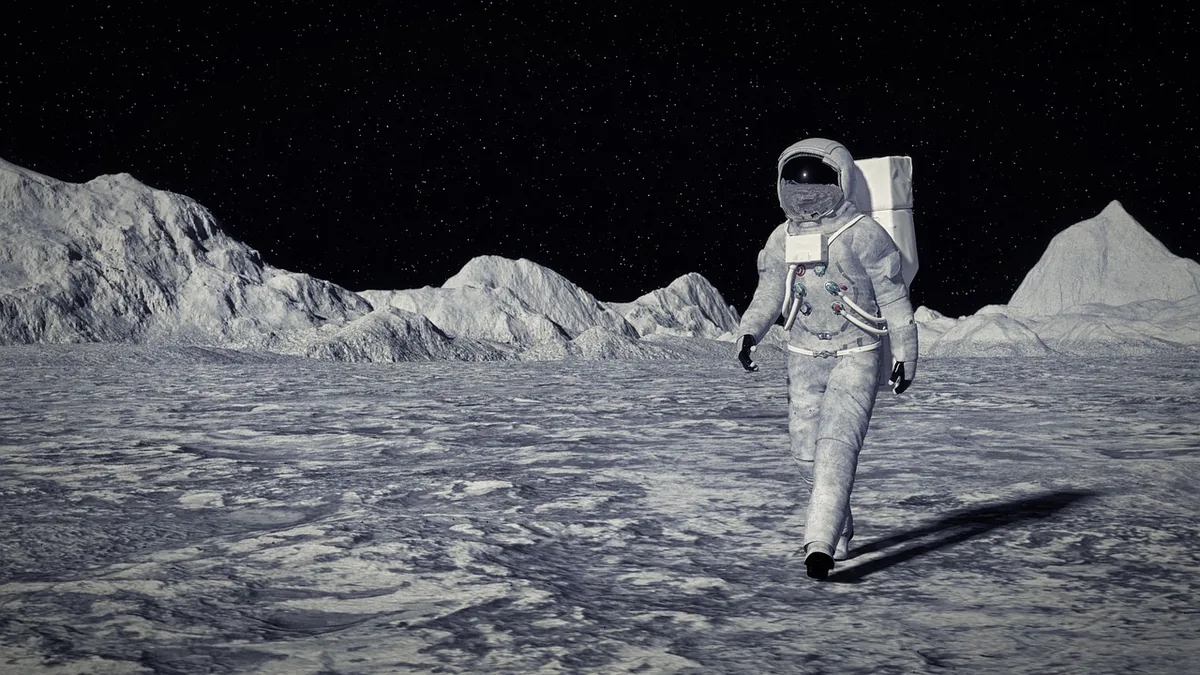
Dust plays havoc with instruments, machine parts, and astronaut health; lunar dust degraded mechanical joints and seals and caused respiratory problems. Martian dust storms range from small daily whirlwinds to global storms once every 3 Martian years, about 5.5 Earth years, though the low density of the atmosphere means these storms do not generate much physical force. <newline>
Mission planners must account for dust when designing spacesuits and infrastructure for Mars, including suits that dock outside habitats, double airlocks, and filtration systems to catch particles smaller than a micrometer. Astronauts pass in and out of vehicles and habitats regularly, so small dust amounts will likely be introduced and, unchecked, become a mounting hazard. VanBommel said dust is a challenge that can be prepared for and overcome, noting researchers have operated rovers on Mars without interruption for more than 20 years. Rover missions advance human spaceflight and have served as test beds for technologies crucial to human exploration when it begins. <newline>
NASA says the results should guide spacesuit design, airlock procedures, habitat filtration systems, and crew-health standards. The rover sampled dust on exposed surfaces rather than measuring airborne concentrations inside a habitat, leaving the indoor effects of contaminated suits as the critical next step. The study also highlights the need for sufficient astronaut training to prepare for the Martian environment using Perseverance data. <newline>
NASA described a preliminary exposure limit of 0.1 mg/m3 for particles under 10 micrometers, averaged across 24 hours for up to 30 days, and said it does not serve as an unrestricted occupational limit for every mission length. The limit is based partly on lunar-dust experiments because scientists lack enough information about Martian particles, and more testing with actual Martian dust is needed. A 2025 medical review warned that Mars dust could threaten respiratory health, and a 2016 study had established its unusual sulfur- and chlorine-rich chemistry. <newline>
Shaunna Morrison, a Rutgers mineralogist not involved in the study, said identifying the dust’s crystal structure remains essential and that scientists ultimately need Martian samples in Earth laboratories. The paper was published in the Proceedings of the National Academy of Sciences, with VanBommel as lead author and Knight as co-author. <newline>
The international team included researchers from the U.S., Canada, Australia, and Europe, with collaborators from MIT Haystack Observatory, Research Institutes of Sweden, CSIRO, the Space Science Institute, ARES at NASA Johnson Space Center, and NASA’s Jet Propulsion Laboratory. Knight, a WashU staff scientist and McDonnell Center fellow, helped conceptualize and conduct the analysis while a Ph.D. student.
“Mars is a very dusty place,” said Scott VanBommel, a research assistant professor of earth, environmental and planetary sciences in WashU Arts & Sciences. “This is bonus science,” VanBommel told Chemical & Engineering News. The team treated accumulated dust on calibration targets and spacesuit patches as bonus science rather than wiping it away, comparing pre-flight Earth X-ray readings with later dusty readings to separate dust chemistry from the underlying material using computer models. <newline>


Join the discussion