Key facts
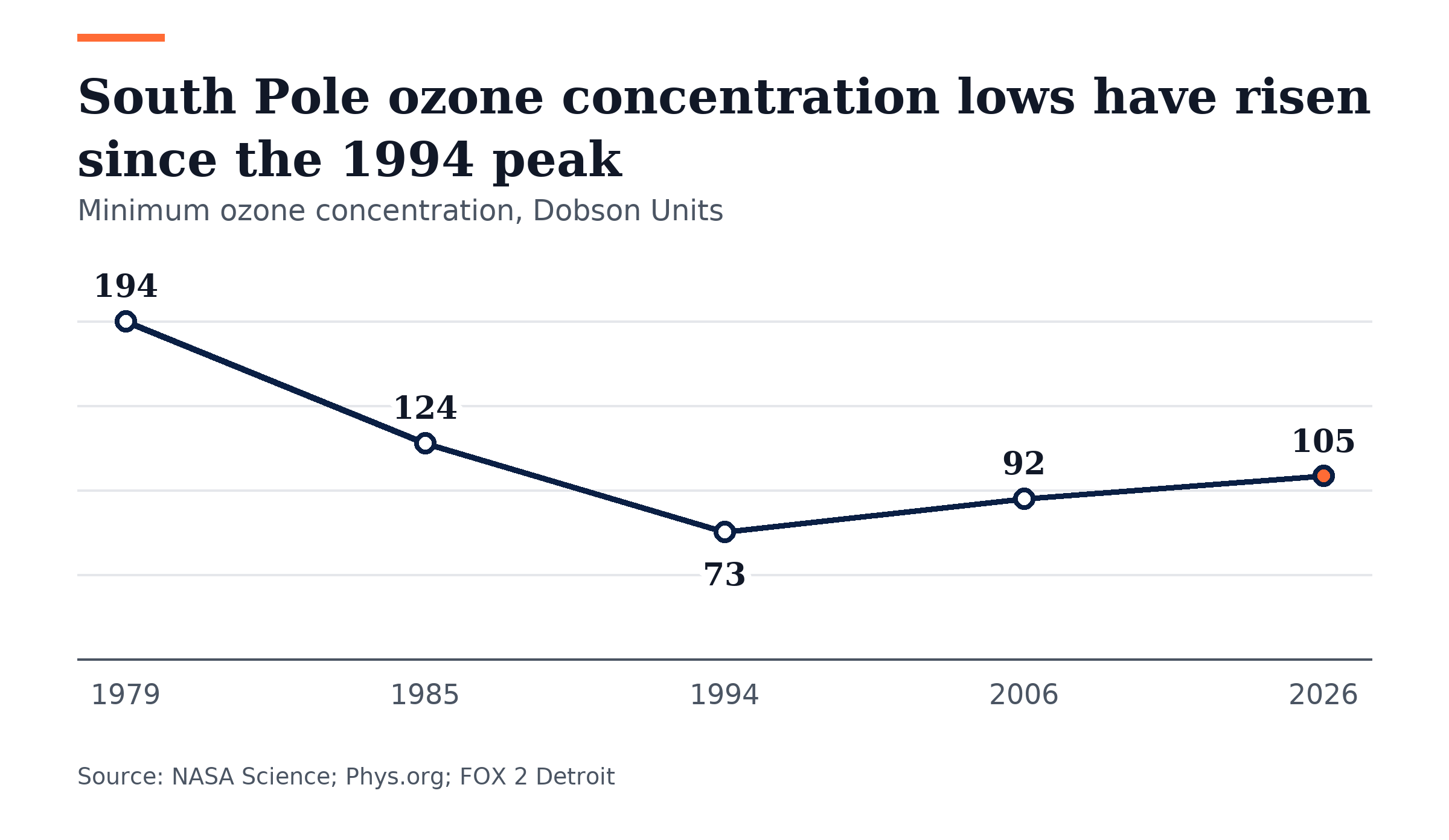
- NOAA scientists using balloon-borne instruments and a Dobson Ozone Spectrophotometer found that ozone directly above the South Pole reached its 2026 low of 105 Dobson units on Oct. 17.
- The ozone hole is a metaphor for areas where ozone concentrations drop below 220 Dobson Units, not a literal empty space.
- Refrigerators and aerosol sprays used chlorofluorocarbons starting in the 1930s, and those chemicals persist for decades in the troposphere without degrading.
- Ultraviolet light in the upper stratosphere breaks chlorofluorocarbons apart and frees chlorine, a reactive atom that drives repeated ozone destruction.
NOAA and NASA scientists found that the 2026 Antarctic ozone hole reached its maximum extent on Sept. 18, 2026, covering 10.5 million square miles over Antarctica. @
The hole placed seventh in a 48-year satellite monitoring record, according to NOAA and NASA analysis. Researchers said its depth did not match other large holes on record, and the depletion was less severe than in record-setting holes from 10 or 20 years earlier. @
Measured across the peak depletion season from Sept. 7 to Oct. 13, 2026, the hole’s average extent covered about 9.6 million square miles, or 25 million square kilometers. That seasonal mean covered more than twice the area of the continental United States, while the single-day maximum reached nearly three times the U.S. area. @
An unusually strong Antarctic polar vortex created ideal conditions for ozone depletion across a large area in 2026. Amy Butler, a research scientist at NOAA’s Chemical Sciences Laboratory, said planetary-scale weather systems that normally break up the vortex were especially weak in August and September 2026. That weak wave action kept the strongest polar vortex winds several degrees of latitude farther from the South Pole, expanding the region where cold conditions could destroy ozone. @
Paul Newman, a senior scientist at the University of Maryland and longtime leader of NASA’s ozone research team at Goddard Space Flight Center, said the hole could have sprawled across 1 to 2 million more square miles if ozone-depleting substances had still been at their year 2000 peak. NOAA and NASA scientists say controls set by the 1987 Montreal Protocol keep driving long-term recovery of stratospheric ozone, so long-term recovery remains on track. @
Stephen Montzka, a senior scientist at NOAA’s Global Monitoring Laboratory, said chlorine levels in the Antarctic stratosphere derived from ozone-depleting substances dropped by roughly one-third compared with 1980s levels. Newman said the annual ozone hole has started later than usual in recent years, which he described as evidence that the ozone layer is healing. @
Researchers documented the initial direct satellite proof of ozone healing in 2018, noting that ozone depletion over Antarctic winters fell 20 percent from 2005 to 2016. In 2019, unusual upper-atmosphere weather over Antarctica sharply reduced ozone depletion and yielded the smallest hole since 1982. @
NOAA scientists using balloon-borne instruments and a Dobson Ozone Spectrophotometer found that ozone directly above the South Pole reached its 2026 low of 105 Dobson units on Oct. 17, 2026. A hundred Dobson units is the amount of ozone that would form a column one millimeter thick if compressed at sea-level standard conditions. The lowest ozone value ever recorded over the South Pole was 92 Dobson units in October 2006. @
Scientists estimate the Antarctic ozone layer is expected to reach 1980 levels in the 2070s. Scientific models indicate that stratospheric chlorine and ozone-depleting substances will stay above pre-1980 levels well into the 21st century. Heise reported that the yearly ozone hole has been shrinking for years and should close entirely by the 2070s. @
The ozone hole is a metaphor for areas where ozone concentrations fall below 220 Dobson units, not a literal empty space in the atmosphere. Scientists had not seen atmospheric ozone concentrations below 220 Dobson units before 1979. The stratospheric ozone layer protects life by absorbing ultraviolet light that damages DNA in plants and animals and causes sunburns and skin cancer. @
British Antarctic Survey scientists using ground-based measurements at Halley Research Station reported dramatic springtime thinning over Antarctica in 1985. NASA satellite instruments later revealed the continental scale of that thinning, which became known as the ozone hole. Ozone concentration first dropped below 100 Dobson units in 1991, and such low readings became more common afterward. @
The deepest ozone hole happened in 1994, when concentrations dropped to 73 Dobson units on Sept. 30, 1994. NASA Earth Observatory identifies 2006 as the year of the largest ozone hole. Other outlets citing NOAA and NASA reporting name Sept. 9, 2000 as the date of the largest ozone hole ever observed. Depth and area records for the ozone hole have never happened in the same year. @
Between 1980 and the early 1990s, the ozone hole quickly expanded in both area and depth. Annual ozone holes roughly stabilized in the early 21st century. Colder stratospheric conditions lead to a larger ozone-hole area and lower ozone values at its center. @
Chlorofluorocarbons and other ozone-depleting compounds were used widely in items including aerosol sprays, foams, air conditioners and refrigerators. These chemicals can linger in the atmosphere or seep from discarded products and landfills for many decades. The chemicals appeared in refrigerators and aerosol sprays starting in the 1930s and can persist for decades in the troposphere without degrading. Ultraviolet light in the upper stratosphere splits chlorofluorocarbons apart, releasing chlorine, a reactive atom that drives repeated ozone destruction. @
NASA Earth Observatory says about 80 percent of the chlorine in today’s stratosphere comes from human activity rather than natural sources. Bromine compounds produced by humans are far less abundant but much more destructive to ozone. When ozone levels fall, more ultraviolet rays reach Earth’s surface, raising the risk of crop damage, skin cancer and cataracts. @
The 1987 Montreal Protocol included an international commitment to swap ozone-depleting substances such as chlorofluorocarbons for less harmful alternatives. 24 countries and the European Community committed to phasing out CFCs. NOAA and NASA track stratospheric ozone with satellites, weather balloons and ground-based instruments. Their network includes October 2026 balloon-borne measurements at the South Pole Baseline Atmospheric Observatory. @
The 2025 ozone hole came in as the fifth smallest since 1992, showing how much year-to-year meteorology can change the outcome. The 2026 Antarctic ozone hole was the largest in a decade, according to NOAA and NASA reporting. @
Absent the 1987 Montreal Protocol measures, researchers estimated that an additional 165 to 215 parts per million of carbon dioxide would have accumulated in the atmosphere by century’s end. Researchers estimated that the added carbon dioxide would have raised global average temperature by roughly 2.5 degrees Celsius and caused complete ozone-layer collapse by the 2040s. @


Join the discussion