Key facts
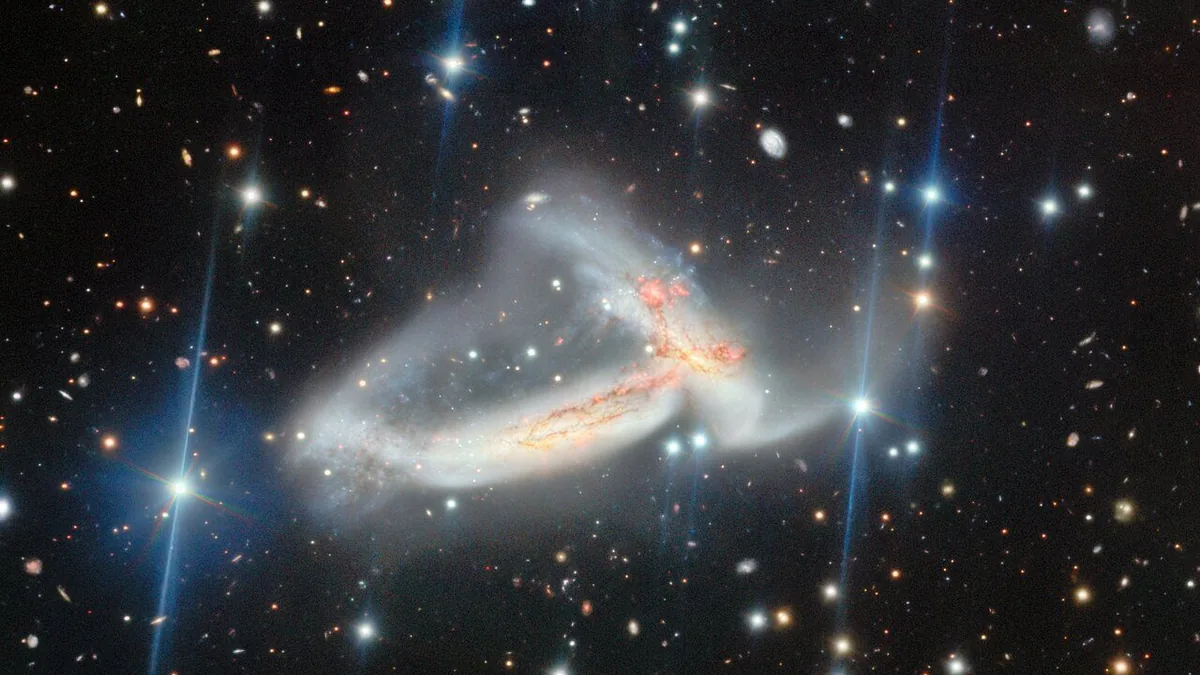
- The 8.1-meter Gemini North telescope on Maunakea, Hawaii, captured the most detailed image yet of the interacting spiral galaxies NGC 7253 and Arp 278 in October 2025.
- Three high school interns in the Project Hōkūlani program at Gemini North selected NGC 7253/Arp 278 as an imaging target and obtained the photograph during a one-week session at the Hilo Base Facility.
- In June 2026, three additional Project Hōkūlani interns gave the galaxy pair the Hawaiian name Nā ʻUhane Māhoe Huki Pū i ke Ola, meaning "the Twin Spirits Pulling Together Creating Life".
- In June 2026, interns Mylin Wilson, Manu Silva-Sampaio and Samantha Silva-Sampaio from Keaʻau High School and Kamehameha Schools joined Project Hōkūlani and created the Hawaiian name for the image.
The 8.1-meter Gemini North telescope on Maunakea in Hawaii captured the most detailed view yet of NGC 7253 and Arp 278, two interacting spiral galaxies, in October 2025.
In October 2025, three Project Hōkūlani high school interns spent a week at the Hilo Base Facility, chose NGC 7253 and Arp 278 as the imaging target, and obtained the photograph. The interns were Raiyan Rahman, Rafan Rahman and Alia Tamanha from Waiākea High School and the Volcano School of Arts and Sciences, two schools on Hawaiʻi Island. Their week at the base facility began the image’s creation, and they used the time to learn how the observatory works, to appreciate Maunakea, and to pick an object for the telescope to image.
In June 2026, three additional Project Hōkūlani interns assigned the Hawaiian name Nā ʻUhane Māhoe Huki Pū i ke Ola to the galaxy pair, which means the twin spirits pull together to create life. The naming interns were Mylin Wilson, Manu Silva-Sampaio and Samantha Silva-Sampaio from Keaʻau High School and Kamehameha Schools. It points to the two galaxies combining over billions of years and setting off new star and planet formation. They shared many aims with the earlier group and expanded on that work.
The system lies more than 200 million light-years away in Pegasus, within the Hawaiian navigational constellation Ka Lupe o Kawelo, and its two members are separated by about four million light-years. NGC 7253 consists of two similarly sized spiral galaxies, NGC 7253A to the north and NGC 7253B to the south. Albert Marth discovered the system on 9 September 1863, and Halton Arp’s catalogue of peculiar galaxies lists it as Arp 278. That disturbed structure made the system unusual enough to earn a place in the catalogue.
Mutual gravity stretches and warps the galaxies’ wispy arms as they slowly spiral toward a merger over billions of years. Gas and dust clouds collide and compress, triggering bursts of new star formation. Radiation from hot young stars strips electrons from nearby atomic hydrogen, and the resulting glow shows up as bright pink H II regions (ionized hydrogen clouds) in the galaxies’ arms. The interaction visibly distorts both spiral arms, and the pink H II regions mark where new star formation is underway.
The photograph was produced under the NOIRLab Legacy Imaging Program, which carries on an effort begun by the International Gemini Observatory in 2002 under the Gemini Legacy Imaging Program name and reserves telescope time for color imaging meant for public outreach. Gemini North is one half of the International Gemini Observatory, operated by NSF NOIRLab, alongside Gemini South on Cerro Pachón in Chile. Public outreach remains a core purpose of the program.
A partnership linking the International Gemini Observatory to the University of Hawaiʻi at Mānoa’s Project Hōkūlani team operates the program. The program supports middle and high school students in entering postsecondary STEM fields through strengths- and work-based enrichment. Both programs give six students from Hawaiʻi Island high schools a yearly chance to choose, photograph and name a new Gemini North image.
Raiyan Rahman said his group picked NGC 7253 in part because it is one of the few objects in Ka Lupe o Kawelo and carried cultural weight after their time on Maunakea. The June 2026 interns researched merging galaxies and star formation while they chose the name. The students tied each piece of the name to a different part of their internship.
The name Nā ʻUhane Māhoe Huki Pū i ke Ola divides into parts representing the two galaxies and the twin observatories. Another part evokes gravity drawing galaxies and communities together, while another points to the new life born of mergers. The students linked the name to the observatory sites in Hawaii and Chile.

Join the discussion