Key facts
- The Vera C. Rubin Observatory in Chile detected a trans-Neptunian object temporarily designated R631 traveling on a retrograde orbit beyond Neptune with an orbital inclination of 142 degrees.
- R631 sits 32 astronomical units from the sun, just beyond Neptune’s orbit at 30 astronomical units.
- Its calculated path puts perihelion on October 31, 2047, at 24 astronomical units from the sun, and one full orbit would take 547.84 Earth-years if the orbit is correct.
- Astronomers and citizen observers monitoring Rubin’s public alert stream noticed R631 after it appeared over four months of data from December 2025 through March 2026.
The Vera C. Rubin Observatory in Chile spotted a trans-Neptunian object, an icy body orbiting beyond Neptune, called R631 moving on a backward path past Neptune, using data gathered from December 2025 through March 2026, and the finding was reported on Nov. 8, 2026. The detection emerged from Rubin’s survey data.
R631 now sits 32 astronomical units from the sun, just past Neptune‘s path at 30 astronomical units. An astronomical unit equals the average distance between Earth and the sun, which puts the object just beyond Neptune.
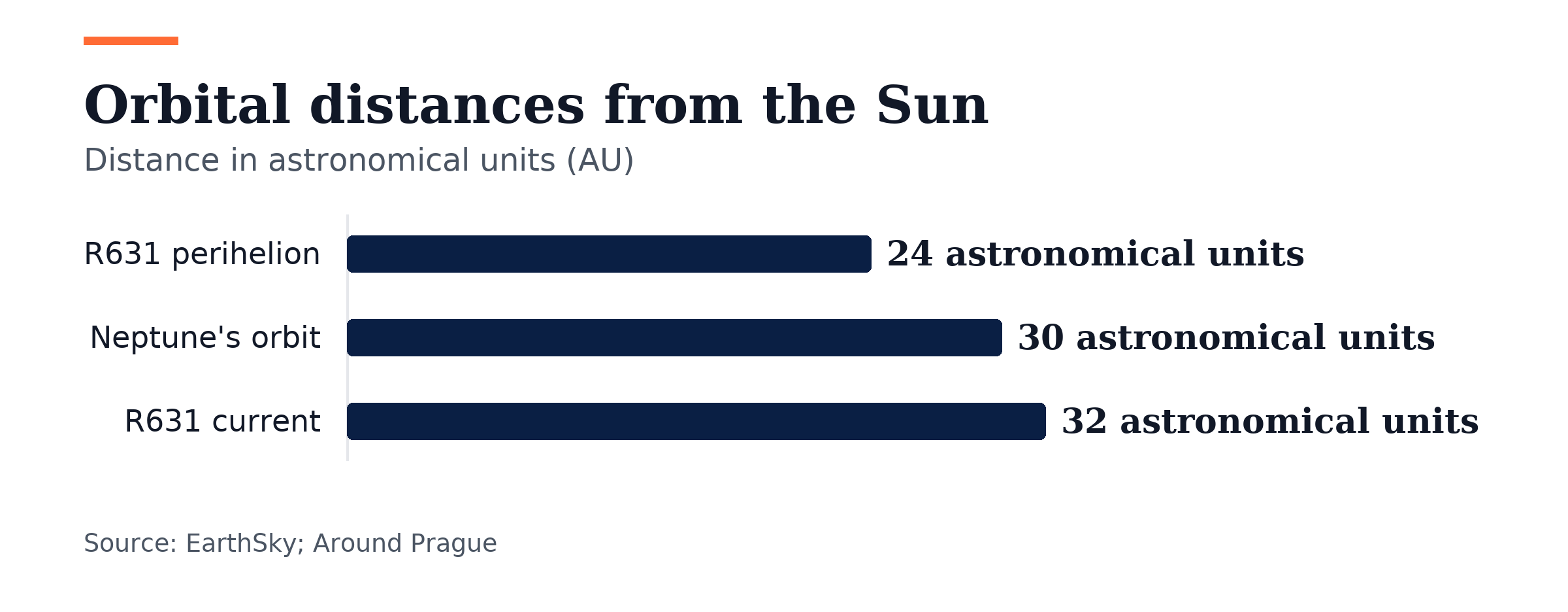
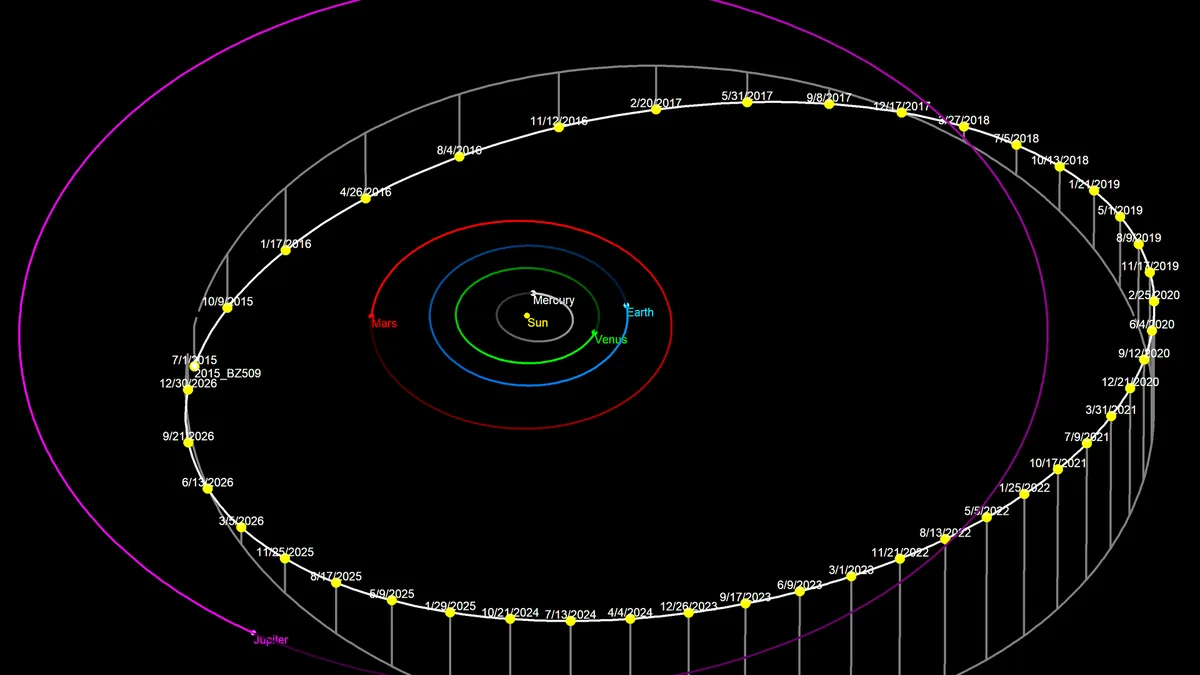
Calculations indicate perihelion, its closest approach to the sun, will occur on Oct. 31, 2047, when R631 comes within 24 astronomical units of the sun, and a complete trip around the sun would last 547.84 Earth-years if the path holds. Those figures depend on an observing arc of only a few months.
In astronomy, retrograde motion describes an orbit tilted more than 90 degrees relative to the plane of the solar system, while most planets, moons and asteroids move counterclockwise when viewed from above Earth’s north pole. R631’s inclination of 142 degrees carries its path past perpendicular, so it travels opposite the direction of most large bodies.
Both professional astronomers and citizen volunteers watching Rubin’s public alert stream noticed R631 as it appeared during a four-month span from December 2025 through March 2026. The object turned up in the public alert stream instead of through a targeted observation. The label R631 is only temporary, pending an official designation from the Minor Planet Center.
Marshall Eubanks, a physicist and astronomer, wrote on the Minor Planet Mailing List that R631 might span 62 miles, or 100 kilometers, and could resemble Comet Bernardinelli–Bernstein, the largest known comet from the Oort cloud. EarthSky called this one researcher’s comment instead of a published measurement, leaving the size far from certain. Around Prague called Eubanks’s view an informal opinion instead of a confirmed observational result.
One idea suggests R631 formed around another star and was captured by the sun’s gravity. Another possibility is that it began in a normal prograde orbit before Jupiter or a passing star knocked it into a backward path during a close encounter. None of these possible origins has been confirmed, and multiple routes could account for the unusual path.
Sam Deen, an amateur astronomer who hunts archival data for missing asteroids and comets, said R631 probably comes from the Kuiper belt after Neptune destabilized it during a close pass sometime over the past billion years. That assessment ranks as one of several unverified ideas about how the object arrived at its current path.
The object carries the same 142-degree tilt as the Great Comet of 1882, along with Comet Ikeya-Seki, Kreutz sungrazers believed to come from one ancient broken comet. Tony Dunn ran a simulation showing R631 does not belong to that group.
Observers could see the Great Comet of 1882 in daylight, and it reached a reported magnitude of -17, compared with the sun’s magnitude of -26. The comet passed so near the sun that it split into pieces.
Comet Ikeya-Seki flew extremely close to the sun in October 1965 and survived, yet its nucleus later split into pieces that slowly disappeared. Researchers believe Kreutz sungrazers came from one huge ancient comet that broke apart hundreds or thousands of years ago.
Should R631 prove cometary, it could display activity such as outgassing near its 2047 perihelion. Observers spotted Comet Bernardinelli–Bernstein releasing jets from 16.6 AU in a report from June 2025. Researchers have not settled whether R631 is a comet or a rocky body. Around Prague observes that current observations do not establish R631’s composition.
The object poses no threat and cannot be seen without a telescope, and no effects on daily life have been reported. Around Prague notes that its worth lies in science rather than practical use.
Researchers can use this tilted object to test ideas about how bodies wind up on unusual paths, whether they started inside the solar system or arrived from beyond it. That connection to how the outer solar system formed helps explain why the tilted orbit carries scientific weight.
EarthSky explains that the solar system began as a spinning cloud of gas and dust, with gravity pulling mass inward to create the sun while leftover material gathered into planets, asteroids, moons and comets. That origin story helps explain why most bodies in the solar system travel in the same orbital direction.



Join the discussion