Key facts
- The Planetary Society reported that Democratic control of Congress replaced Republican control after the midterm election, moving oversight and funding panels for NASA into new hands.
- Rep. Zoe Lofgren, D-CA, will chair the House Science, Space, and Technology Committee, replacing Rep. Brian Babin, R-TX, who becomes ranking Republican.
- Sen. Maria Cantwell, D-WA, will take back leadership of the Senate Commerce, Science, and Transportation Committee, which she led from 2021 to 2025, while Sen. Ted Cruz, R-TX, becomes the ranking minority member.
- Sen. Patty Murray, D-WA, is expected to chair the Senate Appropriations Committee after Troy Jackson defeated Susan Collins, R-ME.
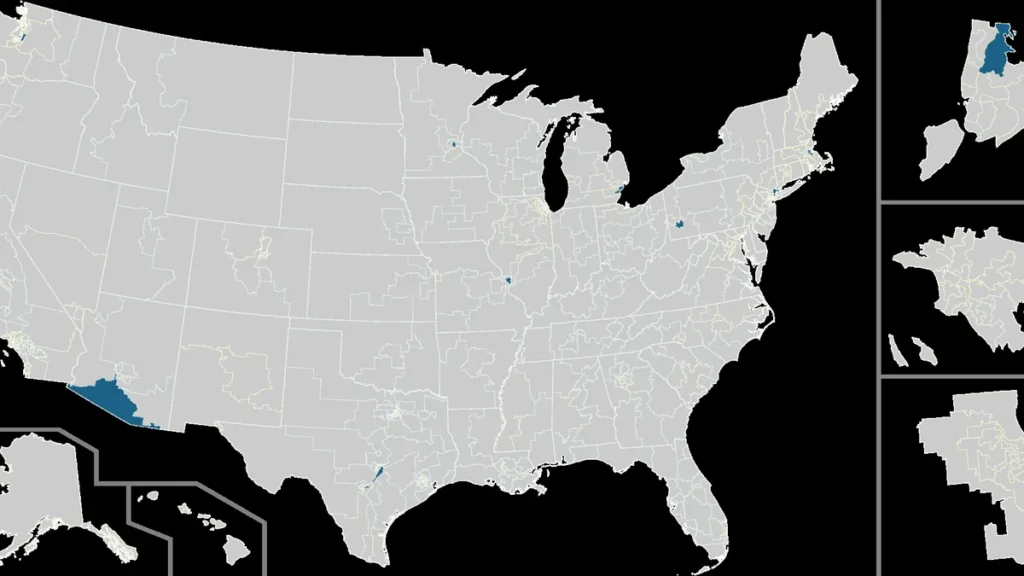
After the midterm election, Democrats gained control of Congress, The Planetary Society reported, putting NASA’s oversight and funding panels under new leadership in the 120th Congress.
Jack Kiraly, advocacy chief at The Planetary Society, hosted a Nov. 4 webinar on what the midterm results mean for U.S. space policy, covering the legislators who will serve on the panels that supervise and fund NASA. SpacePolicyOnline said the session examined committee changes, the NASA authorization and fiscal 2027 appropriations ahead of the Dec. 11 funding deadline, and expectations for the 120th Congress on NASA science. The outlet listed the event as passed and noted that results in some contests might still have been pending.
According to NASA Watch and the Space Foundation, Representative Zoe Lofgren, D-CA, will take over as chair of the House Science, Space, and Technology Committee, with Representative Brian Babin, R-TX, moving to ranking Republican. Its jurisdiction covers more than $40 billion in research and development spending across federal agencies. Zoe Lofgren said, “the tremendous damage that the administration has done to the science enterprise.”
NASA Watch and the Space Foundation also said Senator Maria Cantwell, D-WA, will return to leadership of the Senate Commerce, Science, and Transportation Committee, which she led from 2021 to 2025, with Senator Ted Cruz, R-TX, as the ranking minority member. Gary Peters, D-MI, and Cynthia Lummis, R-WY, are retiring, and Dan Sullivan, R-AK, faces a re-election race that is too close to call.
The Space Foundation said the Democratic majority may bring more focus to federal AI safety standards. It also said Democrats would give closer review to the FCC’s updated satellite licensing rules, and Cantwell published a safe and secure AI framework last month.
NASA Watch and the Space Foundation reported that Senator Patty Murray, D-WA, is expected to chair the Senate Appropriations Committee after Troy Jackson’s victory over Susan Collins, R-ME. Collins currently chairs the committee and sits ex officio on the Commerce, Justice, Science, and Related Agencies Subcommittee. Senator Jeanne Shaheen, D-NH, is retiring from the Senate Appropriations Committee and that subcommittee, and Chris Pappas, a Democrat, will take her place.
The Space Foundation said a Democratic majority on the House Appropriations Subcommittee on Commerce, Justice, Science, and Related Agencies could create major opportunities for federal science after years of budget cuts.
Newly elected members with science backgrounds include Senator-elect Abdul El-Sayed, D-MI, an epidemiologist, and Jasmine Clark, D-GA, a microbiologist who won a House seat to become the first woman with a science doctorate elected to Congress. Bob Walker, a former Pennsylvania representative and space policy adviser, said the change could help NASA science programs.
Jack Kiraly described the election as the most significant change in Congress’s composition since 1992 and said it offers a chance to educate new members on space policy. The Space Foundation framed the midterms as a potential boost for agencies facing budget and personnel reductions.
NASA Watch and the Space Foundation said the administration is seeking $18.8 billion for NASA in fiscal 2027, nearly 25 percent below $24.4 billion.
Under the Trump administration, NASA faced a proposed fiscal 2026 cut of nearly 25 percent, lowering it from $24.4 billion to $18.8 billion. According to the Space Foundation, the reduction would push NASA’s share of federal outlays to its lowest point since 1961 and slash science funding by 47 percent. Astrophysics, Earth science and planetary science would see double-digit cuts, and dozens of missions could be canceled.
Payload said the 2025 proposal would eliminate Mars Sample Return, phase out the Chandra X-ray Observatory and significantly delay the Roman Space Telescope. Appropriators in the House and Senate turned down the deep reductions.
During the fiscal 2026 standoff, the government shut down as of Oct. 1, 2025, and 15,000 NASA employees were on furlough. The House appropriations panel backed $24.8 billion for NASA while the Senate marked $24.9 billion, leaving funding essentially flat from the prior year, though neither chamber has passed a full budget.
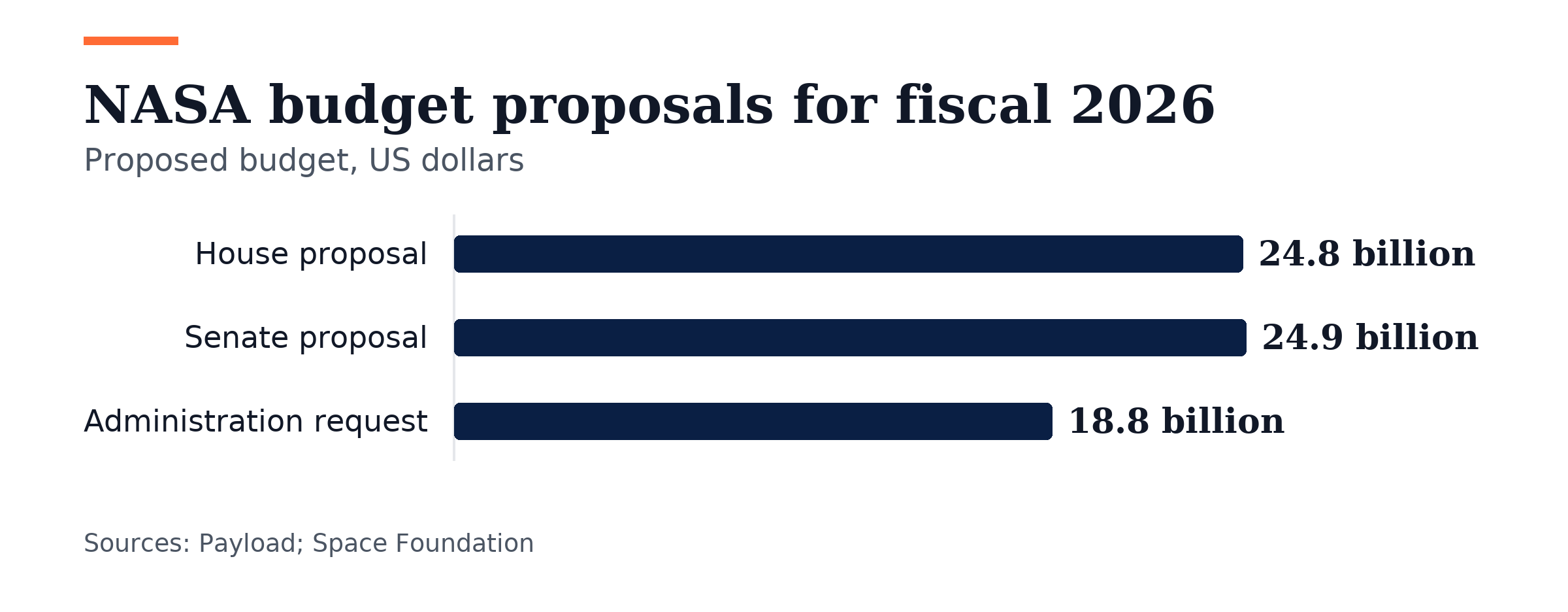
The Trump administration’s budget, released in May, would cut NASA funding by a quarter year over year, from an implemented $24.9 billion fiscal 2025 budget to $18.8 billion for the upcoming year.
Lawmakers have not settled NASA’s fiscal year 2027 budget, and Congress is expected to take up the question in December. The agency also awaits a new authorization act, since Congress last passed a standalone NASA authorization in 2017.
The latest authorization became law in 2022 through the CHIPS and Science Act, though neither chamber passed a new authorization bill in 2026. The Senate NASA authorization bill from Sens. Ted Cruz and Maria Cantwell authorizes $25.3 billion for fiscal 2027 and instructs NASA to construct a permanent base on the Moon, but the bill has not passed the full chamber and will expire unless the full chamber passes it by January 2027.
The Space Foundation said NASA is preparing Artemis III for 2027 to test lunar landers before a crewed Moon flight the following year. NASA also disclosed ambitious Moon Base plans in 2026.
The Space Foundation said an Office of Management and Budget proposal would have senior political appointees review grant applications, making traditional peer-review recommendations advisory instead of binding.
The Planetary Society organized a Capitol Hill day of action in October 2025 with 20 space groups in support of NASA science funding. It occurred while Congress had not agreed on the fiscal 2026 budget and the government remained shut down.
Bill Nye, president of The Planetary Society, said at the Capitol Hill day of action, “We’re talking about the end of it.” Nye also said NASA science is a bargain and contributes much more to the economy than it takes out. He said commercial companies may provide transportation to orbit and some major spacecraft components, but for exploration there is no private path, no profit motive for hunting extraterrestrial life, and no financial return from studying Saturn’s mysterious polar storm.
The Planetary Society is hiring a Community Organizer for its Space Policy and Advocacy team to build a grassroots network of space exploration advocates, and applicants must be authorized to work in the United States. The Downlink posted the job listing next to an award for two Society leaders and a forthcoming Day of Action in Washington.
Casey Dreier, chief of space policy at The Planetary Society, and Jack Kiraly, its advocacy chief, won the 2026 Harold Masursky Award from the American Astronomical Society’s Division for Planetary Sciences, and Kiraly announced the Day of Action dates in Washington, D.C. as Jan. 31 to Feb. 1. The award was presented at the division’s conference last week as the Society pressed to prevent NASA budget cuts.
The Planetary Society said, “The Planetary Society is a nonpartisan nonprofit and does not endorse candidates.” The disclaimer appeared on the event page for the Society’s post-election webinar. Political party meetings to assign committee seats begin during the week of November 10, with Democrats taking control of both chambers and new members joining the panels that oversee NASA and other agencies.




Join the discussion