Key facts
- CCC+TL means covarying coupling constants plus tired light, and the model proposes that evolving fundamental constants govern forces and particle interactions instead of dark matter and dark energy.
- After decades of searching, neither dark matter nor dark energy has been directly detected, and the standard Lambda-CDM model faces questions raised by surprisingly mature early galaxies.
- CCC+TL changes the Einstein and Friedmann equations describing gravity and expansion, so researchers built new CCC+TL-compliant equations and code rather than modifying existing codes.
- The Big Bang nucleosynthesis test found CCC+TL predictions for hydrogen, helium and other light element amounts formed shortly after the Big Bang matched the standard model.
University of Ottawa researchers Rajendra P. Gupta and Nikolaos Samaras tested the CCC+TL model against astronomical observations during 2025 and 2026 at the University of Ottawa. Gupta and Samaras published “A Big Bang Nucleosynthesis Consistency Test of the CCC+TL Cosmology” in the journal Universe in 2026.
CCC+TL means covarying coupling constants plus tired light, and the model proposes that changing fundamental constants control forces and particle interactions rather than dark matter and dark energy. Tired light suggests photons may lose a little energy while traveling across enormous distances.
Researchers have searched for decades without directly detecting dark matter or dark energy, and the standard Lambda-CDM model faces questions raised by surprisingly mature early galaxies. NASA says ordinary matter is about 5 percent of the universe, dark matter roughly 27 percent, and dark energy about 68 percent. Dark matter covers what does not interact with light or the electromagnetic field, can only be explained through gravity, and helps explain how galaxies, planets and stars behave.
Rajendra P. Gupta published “Testing CCC+TL Cosmology with Observed Baryon Acoustic Oscillation Features” in The Astrophysical Journal on March 15, 2024. The authors framed the paper as a check of whether CCC+TL fits baryon acoustic oscillation features in the large-scale galaxy distribution and the angular size of the sound horizon in the CMB anisotropy. Baryon acoustic oscillations are ancient sound-wave patterns left in the distribution of matter.
They could serve as a fundamental standard ruler to test cosmological models.
Carvalho et al. (2016) used 409,337 luminous red galaxies in the redshift range z = [0.440, 0.555] to estimate theta_BAO at six redshift shells. Lemos et al. (2023) provided BAO measurements in 11 thin redshift bins ranging from z = 0.44 to z = 0.66.
Sutherland (2012) stated that the relative weakness of the BAO feature supports a roughly 1:5 ratio of baryons to dark matter. The 2024 paper found an absolute BAO scale of 151.0 plus or minus 5.1 megaparsecs at the current epoch. That equals about 492 million light-years plus or minus roughly 17 million light-years.
The computed angular size of the sound horizon is 0.60 degrees, matching Planck measurements from the last-scattering surface. Researchers set baryon density to all of the matter density and raised the absolute value of alpha by 5.6 percent to match Planck. The CCC+TL last-scattering redshift is 166, compared to 1089 for Lambda-CDM, so sound travels longer in CCC+TL before last scattering. With last-scattering redshift 166 and baryon density set to one, the model gives sound horizon distance 15.5 megaparsecs and angular diameter distance 1.49 gigaparsecs when alpha equals negative 0.845 times Hx.
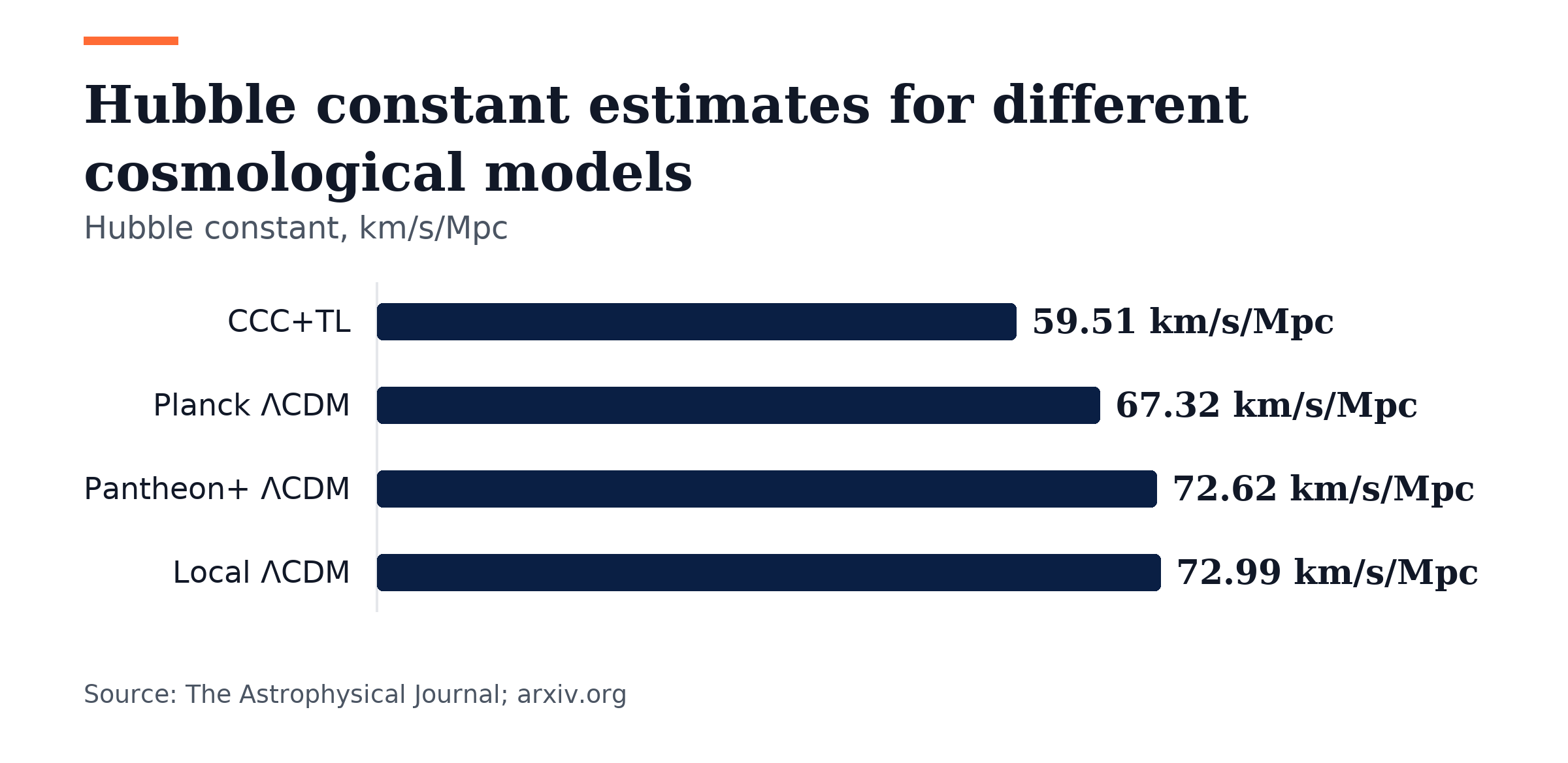
Pantheon+ fitting gave Hc equal to 59.51 kilometers per second per megaparsec and alpha equal to negative 0.7997 times Hc. With 95 percent confidence, Hc equals 59.51 plus or minus 1.06 kilometers per second per megaparsec and alpha equals negative 0.7997 plus or minus 0.0143 times Hc. Ignoring uncertainty, H0 equals 72.62 kilometers per second per megaparsec from Pantheon+ fitting.
For Lambda-CDM with H0 at 72.99 kilometers per second per megaparsec and Omega m zero at 0.351, the BAO scale is 145.2 plus or minus 5.0 megaparsecs, within 95 percent confidence bounds of CCC+TL. The model matches Pantheon+ Type Ia supernova data as well as Lambda-CDM and reproduces JWST cosmic-dawn galaxy angular sizes that conflict with Lambda-CDM.
At cosmic dawn, the standard model places the universe at about 300 million years old, while CCC+TL places it at about 4.6 billion years old at the same observed redshift. Early galaxies less than 500 million years after the Big Bang appear to have shapes, structures and masses similar to older galaxies but with angular sizes an order of magnitude smaller than expected. JWST early galaxies look surprisingly mature for the young universe, leading scientists to reconsider how quickly massive galaxies can form.
The team’s calculations indicate early galaxies are roughly 12 times larger and more massive than standard-model predictions, according to Galaxies 13, 115. In the standard model there may not be enough time for massive galaxies to form at redshifts over 50, while CCC+TL has no such limit. Gupta predicts galaxies exist well beyond the distances the James Webb Space Telescope has reached.
A Monthly Notices of the Royal Astronomical Society paper applied CCC+TL to the 175 SPARC galaxies and reproduced their rotation curves without dark matter. In the Bullet Cluster, the extra gravitational effect predicted by CCC+TL tracks the galaxies rather than the hot X-ray-emitting gas, an early proof of concept needing more study. A separate study of time dilation in supernova observations supports CCC+TL but remains under review.
The Big Bang nucleosynthesis test found CCC+TL predictions for hydrogen, helium and other light element amounts formed shortly after the Big Bang matched the standard model. The model agreed with cosmic-chronometer measurements, which use galaxy ages to estimate how fast the universe has expanded over time.
CCC+TL changes the Einstein and Friedmann equations describing gravity and expansion, so researchers built new CCC+TL-compliant equations and code rather than modifying existing codes. In CCC+TL, the scale factor a equals 1 over 1 plus z, the same relation as in Lambda-CDM. The fundamental constants evolve as c(t) equals c0 times f(t), G equals G0 times f(t) cubed, h equals h0 times f(t) squared, and kB equals kB,0 times f(t) squared.
In CCC+TL, the CMB emission retains a black body spectrum but its intensity scales as (1 + zt) to the power of negative 3 due to the tired-light effect. The sound horizon is the distance sound travels at speed cs(t) in the photon-baryon fluid from the Big Bang until the plasma cools and atoms form at last scattering.
The 2024 paper states it remains unresolved whether CCC+TL fits the cosmic microwave background power spectrum, Big Bang nucleosynthesis, and other critical observations. Currently, there are no CCC+TL parameters fitted to the CMB thermal anisotropy spectrum, so the paper tests the model using Pantheon+ parameters Hc equals 59.51 plus or minus 1.06 kilometers per second per megaparsec and alpha equals negative 0.80 plus or minus 0.01 times Hc. The researchers did not estimate uncertainties for theta_sh, dsh and DA because they were not relevant to their analysis of the model.
Gupta says effects usually credited to dark matter and dark energy probably come from covarying coupling constants, which he examines in a separate paper on their origin. Gupta says standard cosmology blames dark energy for accelerated expansion, but the cause is actually weakening forces of nature as the universe expands, not dark energy. Gupta says his work is the first, to his knowledge, to remove dark matter’s cosmological existence while staying consistent with key confirmed observations.
The results should lead astronomers to treat the new model seriously because it reaches past Lambda-CDM limits, even though difficult to understand and use, Gupta says. Gupta says the findings satisfy the requirement not to conflict with cosmology and astrophysics pillars, including an unpublished cosmic microwave background test. Most emerging models explain only a limited set of observations, Gupta says.
CCC+TL predicts the universe is 26.7 gigayears old against the generally accepted 13.8 gigayears. The 26.7-billion-year CCC+TL age adds extra time that could make large early galaxy formation seem less rushed. Most mainstream cosmology continues to regard dark matter as real despite its unknown particle identity.
“Massive optically dark galaxies unveiled by JWST challenge galaxy formation models.” Xiao et al. (2023) wrote this in The Astrophysical Journal. “We predict that galaxies exist well beyond the distances the James Webb Space Telescope has reached,” Professor Gupta said in the university release.





Join the discussion