Key facts
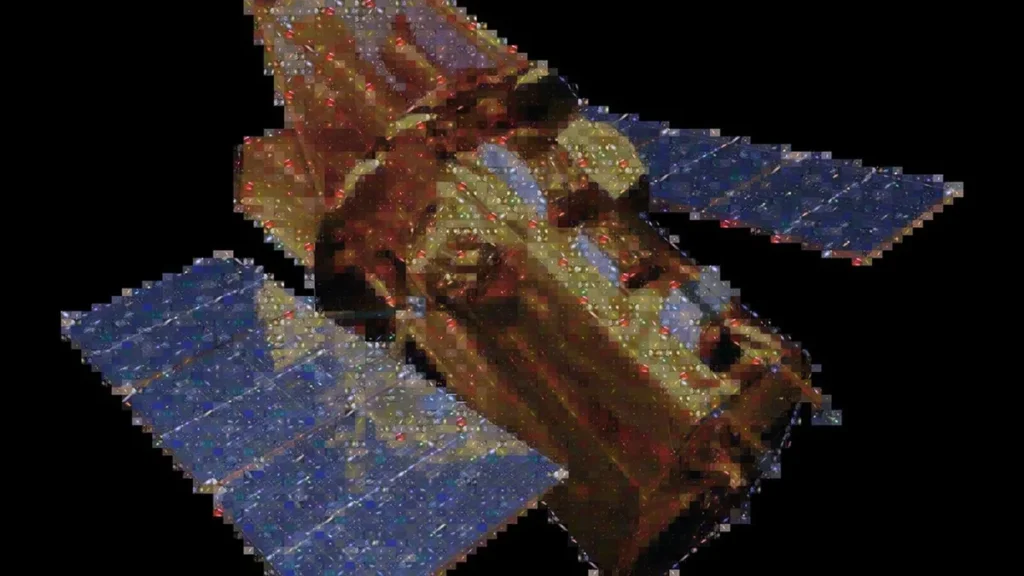
- The APOD picture is a 2018 mosaic assembled from a subset of Swift's first million Ultraviolet/Optical Telescope images.
- Swift disintegrated during reentry as if it were a shooting star.
- In February, controllers halted Swift's normal science observations and tried special maneuvers plus a last-ditch rescue mission to slow its descent.
- Brad Cenko, a NASA astrophysicist and Swift principal investigator, said he understood the rescue failure intellectually but not emotionally.
The Neil Gehrels Swift Observatory re-entered Earth’s atmosphere over Indonesia’s North Sumatra region on November 4, 2026, at 7:39 EST, ending nearly 22 years of service. The satellite ended its mission by entering the atmosphere over Southeast Asia at the time NASA reported, and Yahoo Tech independently confirmed that Swift perished on the morning of November 4 over Indonesia.
NASA’s Astronomy Picture of the Day on November 6, 2026, featured a farewell to the Neil Gehrels Swift Observatory, paired with an explanation written by a professional astronomer. NASA Science publishes APOD daily, pairing one image or photograph with a brief explanation from a professional astronomer, and the November 6 entry used that standard format to mark the conclusion of Swift’s mission. Swift operated for nearly 22 years before atmospheric drag brought it down, and its long service produced a large archive of high-energy observations.
Friction heated and broke Swift apart during its descent on November 4, 2026. Its solar panels likely came off first, then the exterior melted and the frame buckled from the outside in, following the sequence of aerodynamic heating as the spacecraft descended through the atmosphere. Most of Swift disintegrated during free fall, briefly resembling a meteor crossing the sky, and NASA’s farewell note compared the spacecraft’s end to a shooting star. The spacecraft’s end mirrored natural meteoroids entering Earth’s atmosphere.
Stijn Lemmens, a European Space Agency space-debris analyst, said the reentry resembled tossing an appliance into a fire, an analogy that conveys the violence of the spacecraft’s destructive heating and breakup. Swift lacks its own propulsion system, so it had no thrusters to raise its orbit and could not counteract increased drag. The most recent solar maximum accelerated the decay of Swift’s orbit, with the peak in solar activity speeding the orbital decay and linking the faster descent to space weather from the sun.
NASA shut down Swift weeks before November 4, 2026, to prepare for the end. NASA powered down the observatory ahead of its final atmospheric plunge, and it no longer operated when it re-entered. In February, as the orbit decayed, controllers halted Swift’s normal science observations and tried special maneuvers plus a last-ditch rescue mission to slow its descent. With the orbit decaying, the team stopped routine operations to focus on saving the spacecraft, but the rescue bid failed over the summer.
The agency hired Katalyst, a private spaceflight company, to build a vehicle to capture Swift and pull it into a higher orbit, giving the contractor a short window to finish the work. Katalyst engineers had nine months to design, build, and launch the rescue craft, a schedule Brad Cenko, a NASA astrophysicist and Swift principal investigator, called crazy and tight. The compressed timeline reflected the urgency of Swift’s decaying orbit, making the rescue a long shot from the start. While Katalyst engineers prepared the craft, operators angled the cylindrical spacecraft to lower drag, applying a workaround that could reduce altitude loss to buy time.
The Katalyst rescue craft launched in July but tumbled out of control as it neared Swift. The launch occurred after controllers had already halted normal science operations, and the failure left Swift without a path to a higher orbit. The salvage effort failed, and the rescue craft disintegrated in the atmosphere during September, so the rescue vehicle itself became another atmospheric loss. The secondary failure ended any hope of boosting Swift.
NASA had tried to extend the spacecraft’s life by raising its orbit, but the effort failed before reentry, so the satellite could not avoid atmospheric entry. A successful rescue would have added another decade to Swift’s lifetime, meaning the lost opportunity ended the mission years earlier than it might have. NASA and Katalyst could not realize that extension.
Brad Cenko said he understood the rescue failure intellectually but not emotionally, reflecting the team’s disappointment despite their expectations. The rescue attempt failed over the summer, and Cenko’s comment captures that personal letdown. The team considered the hastily assembled rescue effort unlikely to succeed, and understood that, yet the failure over the summer was still emotionally difficult. Yahoo Tech’s reporting described the failed rescue as potentially the most ambitious attempt ever to save an uncrewed spacecraft, placing Swift’s end among other dramatic spacecraft endings.
Swift’s X-ray and gamma-ray telescopes worked together to observe the fastest, most energetic cosmic explosions, letting astronomers study high-energy cosmic transients as they happened. The combined instrument suite was the core capability that distinguished the observatory. Swift could turn toward a brief flash in space within seconds. The article describes this rapid repointing as detective-like behavior, though each maneuver pulled the satellite downward faster as orbital decay, the gradual lowering of its orbit, accelerated.
The observatory looked at gamma-ray flashes originating outside the Milky Way and the light that follows stellar explosions. These were examples of the intriguing phenomena toward which Swift swiveled as its orbit decayed: brief flashes from beyond our galaxy and the fading light after a star explodes. The more Swift maneuvered toward such events, the faster orbital decay pulled the satellite downward.
The data Swift acquired over its mission will continue to bring light to cosmic mysteries for years to come, NASA said. The scientific archive outlives the spacecraft itself, and researchers can keep using the observations after reentry. Swift’s long service produced a large archive of high-energy observations for astronomers to study.
The APOD farewell expressed the hope that Swift will continue to inspire future missions to explore space, data and science, ending on that wish after noting that Swift’s data will keep illuminating cosmic mysteries. The APOD picture is a 2018 mosaic assembled from a subset of Swift’s first million Ultraviolet/Optical Telescope images. NASA selected an image built from early mission data for the farewell page, so the mosaic represents observations captured near the start of Swift’s operations. The telescope captures ultraviolet and optical views of the sky.

Join the discussion