Key facts
- ICEYE launched and deployed four additional synthetic-aperture-radar satellites into low Earth orbit on October 20, 2026, expanding its low-Earth-orbit constellation for Earth observation.
- Two of the four new satellites are assigned to Portugal's Atlantic Constellation, developed with CTI Aeroespacial and the Portuguese Air Force.
- Exolaunch integrated the satellites aboard the SpaceX Bandwagon-5 rideshare mission that lifted off from Cape Canaveral on October 20, 2026.
- The October 20 launch was ICEYE's second of the month; on October 1, 2026, it deployed four SAR satellites aboard Transporter-18, a SpaceX rideshare mission serving ICEYE and dedicated customers.
ICEYE launched and deployed four synthetic-aperture-radar satellites — radar spacecraft that image Earth from orbit — into low Earth orbit from Cape Canaveral on Oct. 20, 2026, expanding its constellation for Earth observation.
The Bandwagon-5 rideshare flight was ICEYE’s second launch of the month, following four SAR satellites deployed aboard Transporter-18 on Oct. 1, 2026. Exolaunch integrated the spacecraft aboard the SpaceX mission. The Atlantic Constellation assignment involves CTI Aeroespacial and the Portuguese Air Force.
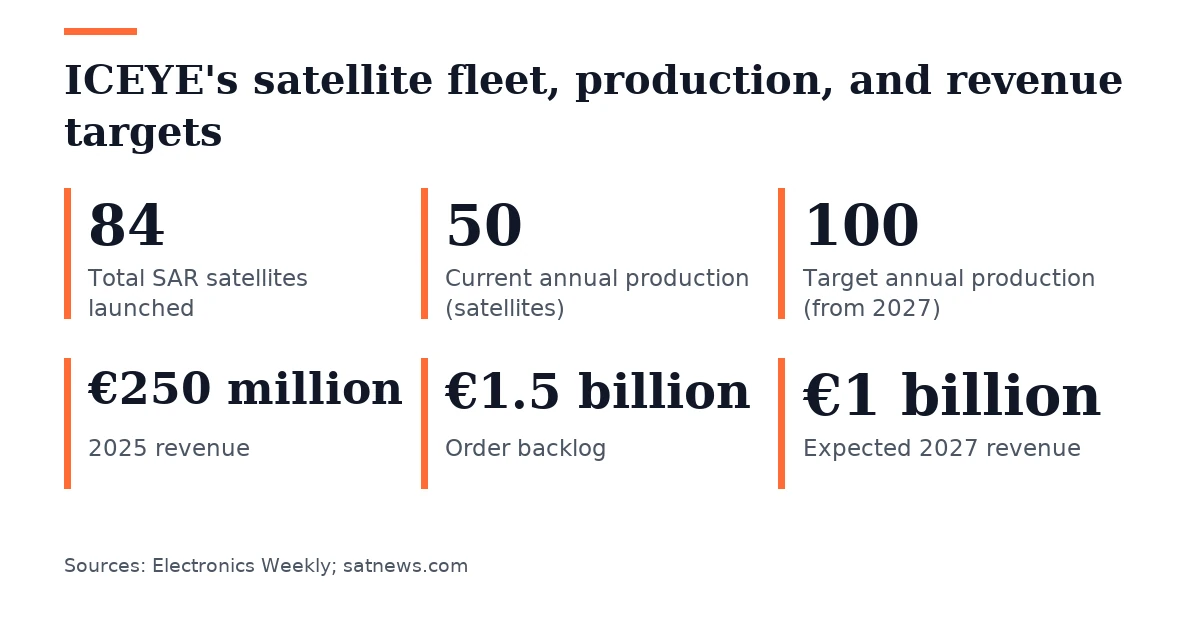
ICEYE has successfully placed 84 SAR satellites in orbit for itself and its customers, and seven European governments have bought sovereign satellite systems from ICEYE. The company says its production rate is doubling and places current output at 50 satellites per year. ICEYE sets a target of 100 satellites annually from 2027 and beyond, saying the pace of launches reflects the faster production rate.
The Portugal assignment builds on ICEYE’s national entity in Portugal, established on July 9, 2026, and led by Rui Costa with a Lisbon center of excellence. The move was part of a 49-day window. During those 49 days, the company stood up national bodies in Germany, Portugal, India, the Netherlands and Korea and appointed a UAE country chief executive.
The first and last announcements were 49 days apart, with the final three arriving inside 72 hours. The rollout hit Germany on July 8, Portugal on July 9, Abu Dhabi on Aug. 3, then New Delhi, Amsterdam and Seoul across three consecutive days. For the UAE, the Aug. 3 move appointed a chief executive over an existing footprint instead of creating a new entity.
ICEYE brought a fully operational sovereign space system to the Polish Armed Forces, moving from contract signing to operational capability in under a year. ICEYE says its sovereign delivery model is being replicated across Europe, the Middle East and Asia, with the pace accelerating.
Poland’s defence ministry signed the roughly €200 million MikroSAR contract on May 14, 2025, and took handover on May 15, 2026; Polish operators fly POLSARIS under ARGUS oversight.
France put roughly €50 million toward DESIR, described as its first sovereign radar demonstrator. One DESIR satellite is set to enter service in early 2029. For DESIR, Loft Orbital serves as prime contractor, Thales Alenia Space supplies the radar payload while TEKEVER handles the active antenna. CNES manages the demonstrator for the DGA, a different pace from Poland’s production-line approach.
ICEYE’s CEO said the country-entity structure responds to governments shifting from buying imagery to buying industrial capability. He said sovereignty goes beyond satellite ownership. He said the company coordinates core technology globally and does not create separate national versions. “sovereignty increasingly goes beyond owning or operating a satellite.” — Rafal Modrzewski, CEO of ICEYE, speaking to SatNews
The company reported 2025 revenue of more than €250 million, EBITDA of more than €100 million and a €1.5 billion order backlog. SatNews characterizes the figures as unaudited company figures without a specified accounting framework. In March, ICEYE CFO Magdalena Bartos told Bloomberg the company expects revenue to top €1 billion in 2027.
A Valencia research and manufacturing center opened on May 7, 2025, under Gonzalo García-Muñoz; Vasilis Chaloulakos became ICEYE Greece’s head nine days later, and Yasuhiro Tsukahara took the Japan chief executive role on Sept. 5, 2025. That groundwork ran for 10 months before the summer’s six national entity announcements.
The India entity commits to building engineering and manufacturing capability inside the country but has no named chief executive or facility date yet. In the Netherlands, an Amsterdam entity pairs with a technology hub inside the Dutch defense industrial base under Joost Elstak. ICEYE Korea appointed Eric Rhee as head instead of chief executive and said the entity dates to June. German production is scheduled to begin at Neuss in Q3 2026, a timeline SatNews tied to a Rheinmetall joint venture and the €1.7 billion SPOCK 1 Bundeswehr award booked in December.
ICEYE US won a place under NOAA’s Space-Based Environmental Monitoring IDIQ contract in the Active Sensors category on Sept. 15, 2026. As part of the award, ICEYE US will supply commercial SAR imagery of land, coastal and ocean conditions to NOAA, with the imagery supporting resource mapping, disaster management, marine surveillance, sea ice tracking and flood and inundation monitoring. The National Reconnaissance Office picked ICEYE US in August 2026 for its operational Radar Commercial Augmentation program after a multi-year evaluation.
ICEYE US chief executive Ann Stevens said the NOAA award opens a long-term pathway and that commercial SAR closes critical observation gaps by seeing through cloud cover and darkness. ICEYE US belongs to what ICEYE describes as the world’s largest SAR satellite constellation, meaning more frequent revisits and imagery delivery in hours instead of days. The company calls itself the owner of the world’s largest and most advanced SAR satellite constellation, with global operations and more than 1,000 employees.


Join the discussion