
Key facts
- The 119th Congress adjourns on the morning of Jan. 3, 2027, and the 120th Congress begins deliberations at noon that day.
- The 120th Congress would have 90 freshman members even if neither party loses a seat, due to an unusually high number of incumbents not seeking reelection.
- Civil space policy runs through four committees: two authorizing panels and two appropriations panels, including the Commerce, Justice, and Science subcommittee that drafts NASA's budget.
- Five House Appropriations members run in toss-up or leaning seats and three are not seeking reelection, but most of the panel, including nearly all of the CJS subcommittee, is expected to remain.
Voters across the United States will cast ballots in the Nov. 3, 2026 midterm elections, and although space policy will not decide any single race, the outcome will weigh heavily on the future of the space program, The Planetary Society said.
The organization describes itself as nonpartisan and says it does not endorse candidates, framing the contest as consequential for NASA while looking ahead to work with the 120th Congress. The 119th Congress leaves three unfinished NASA tasks for its successor: a fresh authorization, a full-year budget for fiscal year 2027, and a proposed overhaul of science grants. All three items land on the desks of the incoming Congress, roughly a fifth of whose members will be brand new.
The 119th Congress will adjourn on the morning of Jan. 3, 2027, while the 120th Congress convenes at noon that same day. The new Congress would have 90 freshman members even if neither party loses a seat because an unusually high number of incumbents are not seeking reelection. Twenty-six House members and three senators face reelection contests in seats rated toss-ups or leaning toward the other party, and The Planetary Society says that turnover should push the freshman class well beyond 90 members.
New members and shifting party control will affect committee membership, legislative expertise, and how the House and Senate handle big-ticket items such as appropriations. Four committees handle civil space policy: two authorizing panels and two appropriations panels, including the Commerce, Justice, and Science subcommittee that drafts NASA’s budget. Authorizing panels set policy direction while appropriations panels approve funds.
Members of the House Appropriations Committee average about 13 years, or 6.5 terms, while their Senate counterparts average just over two terms, giving the panels deep budget expertise. Control of the gavel is the bigger variable, because a shift in House majority would reset every subcommittee chairmanship and open seats for the new majority.
Senator Susan Collins of Maine chairs the full Senate Appropriations Committee and holds an ex officio seat on the CJS subcommittee while running in a toss-up race. Senate CJS subcommittee members Jeanne Shaheen of New Hampshire and Gary Peters of Michigan are retiring from toss-up states, which guarantees turnover on that panel regardless of the outcome. A leadership contest for the full Senate Appropriations Committee could alter the balance of power.
Only the Alaska and Michigan seats are toss-ups on the Senate Commerce, Science, and Transportation Committee, and 21 senators are not up for reelection, so the authorizing panel’s roster should stay the same. Senator Dan Sullivan holds the Alaska toss-up seat, while retiring Senator Gary Peters holds the Michigan toss-up seat on that authorizing panel.
The House Science Committee will welcome many new members despite its average seniority of just over six years. Former chair Representative Frank Lucas of Oklahoma calls the panel the committee of the future and notes that its members regularly reach across the aisle on space policy.
Legislation that fails to become law by a Congress’s end expires; the next Congress must reintroduce it. Any reintroduced bill must pass hearings, a committee markup, votes in both chambers, and final agreement before reaching the president. NASA’s last authorization became law in 2022 as part of the CHIPS and Science Act, while the last standalone authorization dates to 2017, so budget allocations and congressional guidance have shaped civil space policy since then.
On Feb. 4, 2026, the House Science Committee unanimously approved H.R. 7273, and the Senate Commerce Committee unanimously cleared its own version one month later. The Senate authorization bill sets NASA’s fiscal year 2027 budget at $25.3 billion, directs the agency to build a permanent Moon base, and extends International Space Station operations to 2032 among other directives. Neither authorization bill has passed its full chamber, and neither chamber has taken up the other chamber’s bill.
A post-election push for NASA authorization would have to compete for floor time with must-pass measures such as the defense policy package and government funding, alongside the farm bill and expiring health care programs. With only about 20 in-session days left before the 119th Congress ends, timing is tight for any authorization vehicle, including one attached to a must-pass bill. If the pattern holds, one or both current NASA authorization bills could be reintroduced in the 120th Congress, a decision for newly formed committees and possibly new chamber leadership.
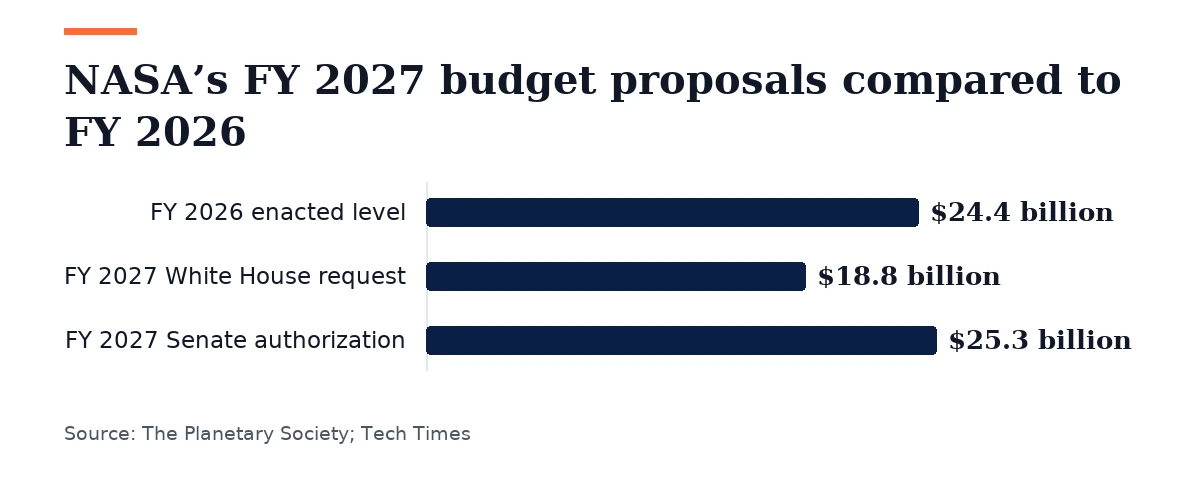
A continuing resolution enacted Sept. 2, 2026, funds the government through Dec. 11, 2026, and keeps NASA at its fiscal year 2026 level of $24.4 billion. The stopgap tops the $18.8 billion the White House requested for fiscal year 2027 and pauses the Office of Management and Budget’s Uniform Guidance changes. The stopgap also prevents NASA from starting new programs or changing course on existing ones. If Congress reaches no funding deal by midnight on Dec. 11, 2026, the government will shut down and the grant changes will begin to take effect.
Reports say some agencies have already put political reviews and grant slowdowns into place ahead of the deadline. The House Appropriations Committee advanced all 12 fiscal year 2027 bills, including the CJS bill funding NASA, but the full House passed only three and left out CJS. As Congress entered its September 2026 recess, the Senate Appropriations Committee had not released any of its 12 fiscal year 2027 bills.
The House bill turned back many proposed cuts to NASA but would cut NASA Science from $7.3 billion to $6 billion while boosting human spaceflight. Senate CJS chair Jerry Moran of Kansas and ranking member Chris Van Hollen of Maryland voiced strong support for a fully funded NASA at a May hearing with Administrator Jared Isaacman. Only 20 working days remain in the calendar year for fiscal year 2027 appropriations, and the continuing resolution expires in the middle of that window.
For fiscal year 2026, the White House proposed cutting NASA science nearly in half, but Congress rejected the proposal largely because of advocates. The Office of Management and Budget proposed the same cuts again for fiscal year 2027, drawing opposition from both parties. The office also proposed rewriting federal grant rules to block public sharing of research results and to require political appointee approval of funding decisions, a plan that faced bipartisan backlash and public opposition.
NASA’s science program operates with fewer people and less research funding than Congress intended, and research and analysis programs that fund basic research and mission data analysis would feel the first pain from funding interruptions. Planetary scientist Mark Sykes used Freedom of Information Act records to show that planetary research and analysis funding was effectively flat from fiscal year 2011 through fiscal year 2025, and inflation erased more than 30% of its value across that span. The planetary decadal survey and the CHIPS and Science Act set a 10% research-and-analysis spending goal, but fiscal year 2025 came in almost 50% below it. Through June 30, 2026, NASA had spent less than half of the fiscal year 2025 planetary research and analysis budget.
In 2025, roughly 3,870 NASA workers sought to exit through the deferred resignation program, cutting the civil service from approximately 18,000 to about 14,000 people. The Goddard Space Flight Center ranked among the centers hardest hit by the departures. Administrator Jared Isaacman has led a campaign to rehire positions and move contractors into civil service, but lost experience cannot be replaced overnight. Students and early-career scientists are watching the grant pipeline shrink and letting that shape their career decisions.
The administration’s top NASA priorities – the Moon base and the Ignition initiatives – have not been tested in law, and congressional authorization would supply the legislative test they lack. At the Ignition event on March 24, 2026, Administrator Jared Isaacman announced that the Gateway lunar station would pause indefinitely. NASA instead plans a lunar south pole outpost built in three phases across a decade, starting with up to 30 robotic landings in 2027.
NASA estimated roughly $20 billion for the lunar base over seven years and about $6 billion more for expanded Commercial Lunar Payload Services. NASA also announced Space Reactor-1, a nuclear demonstration mission to Mars that would deploy the Skyfall mission of three Ingenuity-class helicopters to the Martian surface. None of the Ignition initiatives has faced a legislative test, and the fiscal year 2027 budget request released days after the March 24 event omitted funding lines for the Moon base and other initiatives.
According to Jared Isaacman, NASA does not face a top-line shortfall but rather a question of resource allocation. Moving money from existing programs into new ones would require congressional approval, which the current continuing resolution does not provide. The Senate authorization provides clear direction for the Moon base, while the administration points to roughly $10 billion for human spaceflight in the 2025 reconciliation law, resources that stretch across programs including the Artemis timeline. The Moon base and Ignition programs have not received their own funding line in any regular appropriations bill.
NASA awarded nearly $1 billion in Moon Base contracts to four companies in May 2026, targeting the first mission for launch no earlier than fall 2026 after the Artemis II crewed lunar flyby on April 10, 2026. Astrolab received $219 million for its CLV-1 crewed lunar vehicle, while Lunar Outpost received $220 million for its Pegasus rover. Blue Origin received an initial $188 million contract under the Commercial Lunar Payload Services framework to deliver rovers using its Blue Moon Mark 1 lander, and the deal includes a $280.4 million option period for two additional task orders.
Firefly Aerospace received a $75 million subcontract through the Jet Propulsion Laboratory to build the carrier spacecraft for the MoonFall mission. MoonFall is a 2028 technology demonstration that will deploy a swarm of hopper drones over the Moon’s South Pole.
The overall Moon Base architecture is estimated at about $20 billion over the first seven years. Casey Dreier of The Planetary Society questioned whether $20 billion would be sufficient to build and sustain a lunar base over seven years. The fiscal year 2027 budget request proposes roughly a 23% cut to NASA’s overall budget, from $24.4 billion enacted for fiscal year 2026 to $18.8 billion. Congress rejected a nearly identical fiscal year 2026 cut and passed the higher figure.
House appropriators advanced a fiscal year 2027 bill that backs the Moon Base and funds the Human Landing System at $2.28 billion.
The 2024 post-election lame-duck Congress operated under a continuing resolution set to expire Dec. 20. After that election handed Republicans control of the White House and both chambers, Congress passed a CR through March 14, 2025, allowing the incoming government to set spending levels. A shift in party control of Congress leaves the incoming majority with little incentive to set spending before taking charge, and leaves the outgoing majority unable to compel an agreement. If control of the House, the Senate, or both shifts on Nov. 3, the same appropriations incentives would follow.
Senate Minority Leader Chuck Schumer of New York and House Appropriations Chair Tom Cole of Oklahoma have said they want to finish appropriations during the lame-duck session. Finishing appropriations in the lame duck remains possible but unlikely because of timing and defense spending disputes between Democrats and Republicans. Defense spending serves as a wedge issue, making it likely that funding decisions will slip into the 120th Congress.
More than 100 former NASA astronauts launched Astronauts For America in April 2026, a nonpartisan voter education effort co-chaired by Garrett Reisman and Steve Lindsey. From summer 2026, the astronaut group toured college campuses and town halls to encourage young and first-time voters to vote. Astronauts carry public trust as symbols of competence, teamwork, and national pride, yet specific NASA funding and direction decisions occur later in committee rooms, where advocacy continues after election day.

Join the discussion