
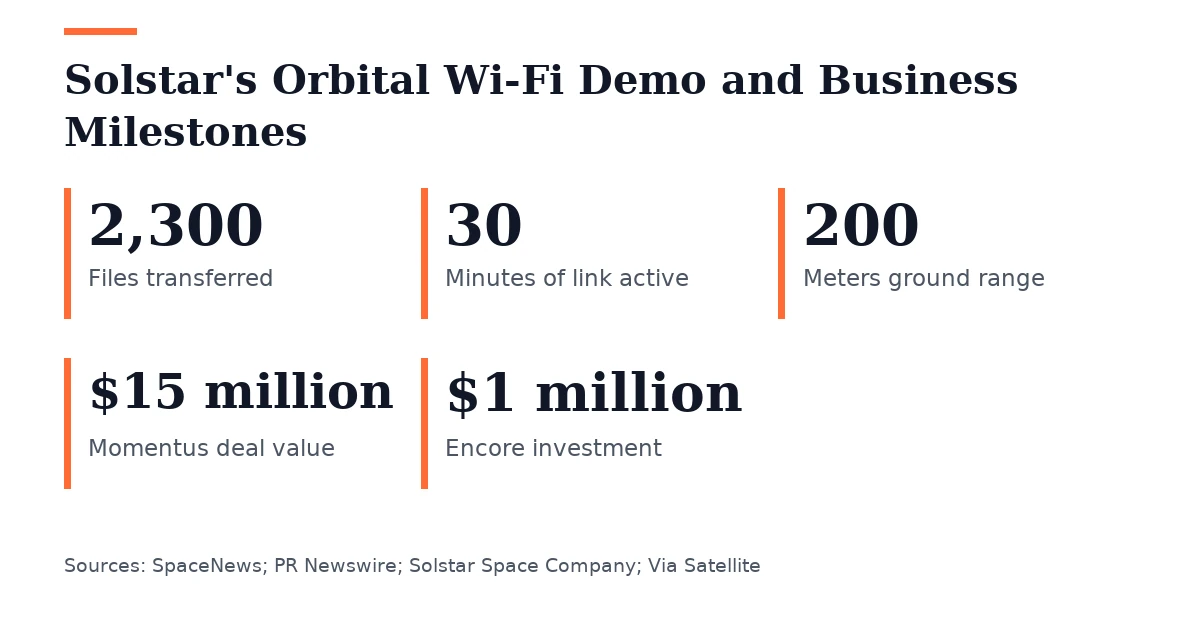
Solstar Space announced on Oct. 20, 2026 that its Wi-Fi technology connected NASA’s R5-S10 cubesat with Momentus’ Vigoride-7 orbital service vehicle during proximity operations and relayed data to NASA’s Johnson Space Center. A San Francisco announcement described the October 20 link as an early commercial in-orbit wireless demonstration tied to satellite servicing and orbital infrastructure. \n\nSolstar’s Deke Space Communicator spent about 30 minutes in proximity operations sending more than 2,300 files of optical, infrared and lidar data from orbit to NASA Johnson, with Iridium Communications supplying the experimental relay link. The files were collected from the S10 and Vigoride-7 spacecraft at varying distances and under multiple lighting conditions during the demonstration. \n\nNASA’s Small Spacecraft & Distributed Systems and the Engineering Directorate at NASA Johnson fund and manage the R5-S10 technology demonstration mission. SSDS is based at NASA’s Ames Research Center in California’s Silicon Valley within the Research and Technology Mission Directorate. Solstar’s announcement includes the program management detail for the successful demonstration. \n\nIn a single on-orbit demonstration, the mission merged maneuvering, navigation, proximity operations and satellite relay into one on-orbit demonstration. These integrated capabilities could support satellite servicing, in-orbit assembly and future commercial destinations. Brian Barnett, founder and CEO of Solstar Space Company, said the company is proud to work alongside NASA, Momentus and Iridium to demonstrate a new level of connectivity for spacecraft operating in close proximity. The statement accompanied the announcement of the successful proximity operations mission. \n\nEthan Haase, Iridium vice president of government solutions, said the mission offered a chance to experiment with how Iridium’s constellation can support new types of on-orbit operations. Haase commented on the experimental nature of the demonstration in a news release. John Rood, CEO of Momentus Space, said Solstar added an important communications dimension to the mission and that combining interoperable technologies expands what is possible on orbit. Rood praised the strategic partnership in a news release about the successful proximity operations mission. \n\nSolstar and Momentus signed a three-year reciprocal services agreement worth up to $15 million to combine Solstar’s space-based communications products and services with Momentus logistics, launch, payload deployment and on-orbit services. The companies planned to jointly market in-space data relay and logistics capabilities, including a Solstar payload on Vigoride-7. \n\nBarnett said the NASA mission provided extensive data to train artificial intelligence models for future autonomous missions including proximity operations. He linked the data to the demonstration’s proof of on-demand connectivity for autonomous spacecraft operations. \n\nNASA’s Wi-Fi-enabled cubesat connected with Solstar’s Deke Space Communicator aboard Vigoride-7 during pre-launch ground tests, which showed the communications link extended more than 200 meters. Solstar said these tests were conducted on the ground before launch to establish communications between spacecraft. \n\nBarnett said that after three previous spaceflights and more than 10 years of work, what has emerged is a commercial product. He said Wi-Fi enabled payloads can remain in constant contact with ground controllers, a capability needed 24/7 for manufacturing, satellite servicing or lunar operations. Barnett explained why continuous contact with equipment matters for those space activities. \n\nMomentus’ Vigoride-7 orbital service vehicle launched on March 30, 2026, to provide narrowband internet connectivity and local in-space wifi for Vigoride payloads. The vehicle carried Solstar’s Deke Space Communicator on its first orbital flight. \n\nSolstar tested its technology on four Flight Opportunities suborbital campaigns aboard three commercial vehicles, including an April 2018 test that demonstrated the first-ever commercial wifi service in space with a social media post from above the Karman line. NASA says the flight tests helped mature Solstar’s wifi technology and confirmed commercial satellite networks can provide internet and voice communications in space. \n\nIn June, Encore Technologies Corp. announced a $1 million investment in Solstar, which the company said further validates what Solstar is building as it moves into its next stage of growth. The investment preceded the October announcement of the NASA proximity operations demonstration. \n\nSolstar received a NASA Phase I Small Business Innovation Research contract valued at $150,000 on Oct. 9, 2025, to develop a next-generation Lunar Wi-Fi Access Point supporting Artemis and Commercial Lunar Payload Services initiatives.


Join the discussion