
Key facts
- During a livestreamed event at a SpaceX facility in Texas, reported on Oct. 16, 2026, Elon Musk unveiled a second-generation Tesla Roadster fitted with thrusters derived from SpaceX technology.
- In the demonstration, the Roadster drove up an inverted ramp, rotated in midair, and landed back on its wheels using forced air and thrusters.
- The vehicle also jumped over a Cybercab, a Cybertruck, a Tesla Semi, a Model Y, and a Model 3 during the event.
- The demonstration vehicle operated without a driver, which Musk said was to make sure no one was killed.
On Oct. 16, 2026, Elon Musk unveiled a second-generation Tesla Roadster fitted with thrusters derived from SpaceX technology during a livestreamed event at a SpaceX facility in Texas. The vehicle uses 10 nozzles and ultrahigh-pressure air tanks, with roughly 600 liters of compressed air stored in carbon-fiber-overwrapped pressure vessels.
In the demonstration, the Roadster drove up an inverted ramp, rotated in midair, and landed back on its wheels using forced air and thrusters. During the same display it jumped over a Cybercab, a Cybertruck, a Tesla Semi, a Model Y, and a Model 3. The vehicle operated without a driver, which Musk said was to make sure no one was killed.
Tesla claims the Roadster accelerates from 0 to 60 mph in under one second and reaches a top speed of about 230 mph. Musk asserted the vehicle could reach roughly 380 mph, which he described as halfway to the speed of sound.
Musk said the Roadster uses 10 nozzles and ultrahigh-pressure air tanks (which store air at very high pressure) to propel itself into the air and accelerate on the ground. Tesla Engineering Vice President Lars Moravy stated the propulsion system relies on 10 thrusters connected to roughly 600 liters of compressed air that can be recharged. The vehicle’s available interior spaces are packed with carbon-fiber-overwrapped pressure vessels (tanks wrapped in carbon fiber to withstand high pressure) to hold the compressed air supply.
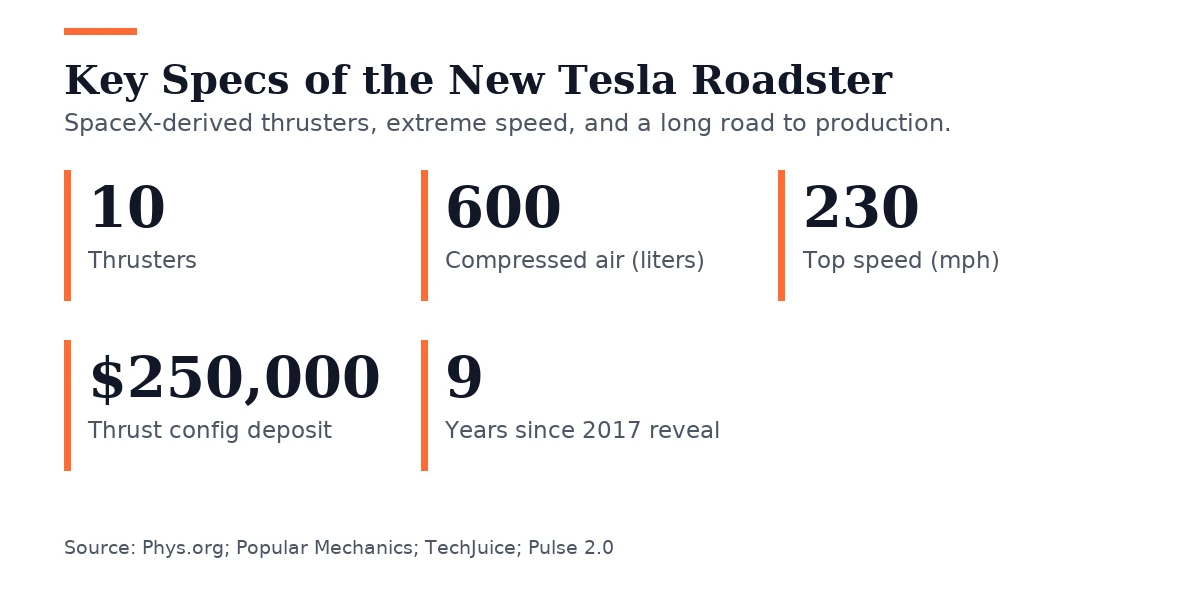
Tesla is offering the Roadster in three configurations: Performance, Thrust, and Rocket. The Performance configuration is a two-seater with active aerodynamics and a multimode suction system, backed by a $50,000 reservation deposit. The Thrust configuration adds rear-mounted cold-gas thrusters (thrusters that expel pressurized gas to produce thrust) and requires a $250,000 deposit. The Rocket configuration is a single-seat, invite-only model equipped with 10 cold-gas thrusters for aerial maneuvers.
Tesla says production of the Roadster is planned to begin in 2028, a date Musk has a track record of pushing back. The Roadster program has been delayed for roughly nine years since Tesla first revealed the second-generation design in 2017.
Musk described the vehicle as not necessarily a safety-optimized car and told safety-focused buyers to look elsewhere. Musk acknowledged he is unsure the Roadster is legal in all jurisdictions, but said a car will exist that someone can own. Musk said the Roadster’s success is not guaranteed, though he added that it will probably work.
Tesla’s stock rose about 5% in premarket trading on Friday after the event. “You’re going to see some crazy stuff tonight,” Elon Musk said.
Gene Munster suggested the event was an engineering flex with no commercial value that could promote a potential Tesla-SpaceX merger. Marques Brownlee questioned the 2028 delivery date and the vehicle’s physics, asking whether the announcement was a prank.
BBC technology editor Zoe Kleinman explained several reasons a flying car is unlikely to reach roads in the near term. “Flying cars are real,” Elon Musk said.
Glenn Curtiss debuted the first flying car prototype in 1917. Stanley Hiller Jr. pursued flying cars in the 1950s and 1960s with the Hiller Hornet and Aerial Sedan, but military funding ended and they never reached consumers. A 1957 Popular Mechanics cover promised the Hiller Aerial Sedan as a flying car for 1967, but the U.S. Army later scrapped its flying-car program, ending the project.
Popular Mechanics featured Kenneth G. Wernicke’s Aircar in 1994, yet no flying-car design has reached a dealer showroom.
Join the discussion