
Neutrino flavor conversion—the process where neutrinos switch types—may determine whether a massive star explodes as a supernova or collapses directly into a black hole, according to simulations by researchers at the University of Copenhagen.
Neutrinos come in three flavors—electron, muon, and tau—and each flavor interacts with matter in a distinct way. When neutrinos change flavor, a process called flavor conversion, the energy they deposit in a collapsing star’s core shifts.
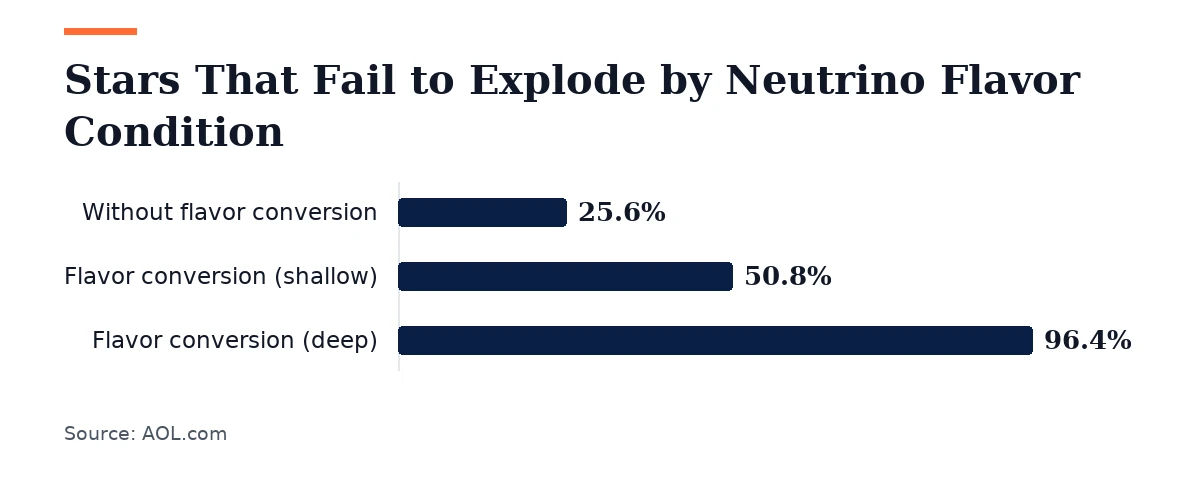
Simulations of 195 stars with masses ranging from 9 to 120 solar masses showed that neutrino flavor conversion increases the likelihood of a star collapsing into a black hole instead of exploding, especially for stars between 16 and 30 solar masses. Without flavor conversion, 25.6% of simulated stars failed to explode; with flavor conversion, failure rates rose to 50.8% at shallow depths and 96.4% at deeper depths, with the strongest effect in the 16–30 solar‑mass range.
The study suggests neutrino flavor conversion may explain the ‘supernova rate problem,’ where observed supernovae are fewer than theoretical models predict, by increasing the rate of ‘failed supernovae’ that collapse silently into black holes. Massive stars synthesize heavy elements during their lifetimes, and supernova explosions distribute these elements into space, contributing to the formation of planets and life, while direct black-hole collapse traps them.
Dust or direct black-hole collapse can obscure supernovae, making them invisible to telescopes and contributing to the discrepancy between predicted and observed supernova rates. Current supernova simulations treat stars as perfect spheres and assume instantaneous neutrino flavor conversion, which may overestimate failure rates.
Researchers need more detailed models to refine predictions. Observed neutron stars typically weigh 1.2–1.4 solar masses, but simulations without flavor conversion produce heavier remnants; including flavor conversion yields lighter neutron stars, aligning better with observations.


Join the discussion