Key facts
- Astronomers observed a star shredded by a black hole more than 1,000 parsecs from its galaxy’s centre in TDE 2023mfm.
- Optical/UV photometry came from ZTF, Hubble and Swift; optical spectroscopy was obtained with Keck and Lick observatories.
- X‑ray observations were taken with Chandra and XMM‑Newton; multifrequency radio data came from the Very Large Array.
- The optical light curve peaked after ~30 days and then declined gradually over roughly 100 days.
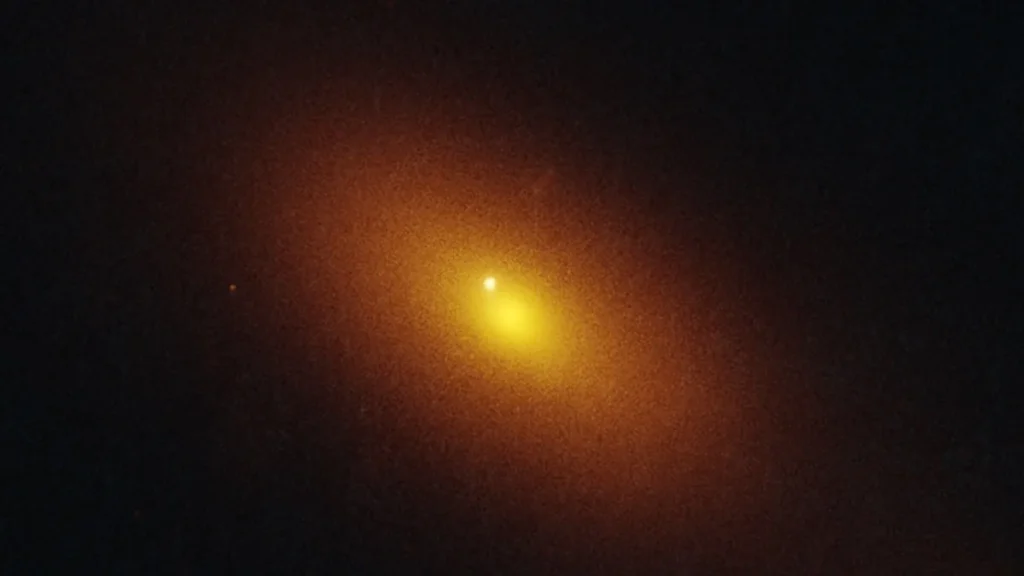
Researchers saw a star torn apart by a black hole situated over 1,000 parsecs away from the center of its host galaxy during the tidal‑disruption event known as TDE 2023mfm.
TDE 2023mfm is located 1.08 kiloparsecs from its host galaxy’s nucleus, which corresponds to roughly 3,500 light‑years. The black hole’s mass was estimated to range from 1 million to 10 million solar masses, based on three separate measurement techniques.
Observatories ZTF, Hubble and Swift provided optical and ultraviolet photometry, while Keck and Lick supplied optical spectroscopy. Chandra and XMM‑Newton gathered X‑ray data, and the Very Large Array supplied multifrequency radio measurements.
The optical brightening reached its peak after about 30 days and then faded slowly over approximately 100 days. Analysis of the spectral energy distribution indicated an optical/UV temperature near 20,000 kelvin, which remained steady for over a month following the peak. The host‑subtracted optical spectrum of TDE 2023mfm displayed a distinct broad hydrogen emission line.
Observations showed no X‑ray emission originating from the tidal‑disruption event, while a weak X‑ray source detected nearby appears to come from the galaxy’s core. Radio telescopes detected no emission from TDE 2023mfm until roughly 991 days after the disruption, after which the radio signal changed only gradually. ZTF alerts and high‑resolution images in optical, ultraviolet and radio bands revealed the off‑nuclear location of TDE 2023mfm.
One possibility is that the black hole remains from a dwarf galaxy that merged with the host and lost its stellar component. Another explanation is that gravitational‑wave recoil flung the black hole out of a triple‑black‑hole system. A third scenario attributes the offset to a recoil kick from a black‑hole merger that ejected the resulting hole from the galaxy’s center.
The host galaxy’s center contains a faint active galactic nucleus, suggesting a second black hole that supports the minor‑merger hypothesis. Investigating massive black holes located away from galactic centers aids in understanding the population and evolution of intermediate‑mass and massive black holes. “we conclude that TDE 2023mfm is an off-nuclear TDE-H”, the team said
Wandering black holes retain information about the violent merger histories of their host galaxies and about the formation of the first massive black holes. According to the ASTRID simulation, low‑mass galaxies decrease in likelihood of hosting a central black hole as time progresses. A 2025 survey of 1,606 galaxies revealed that roughly one‑third of dwarf galaxies ranging from 100 million to one billion solar masses host a central massive black hole.
As a result, these galaxies more likely contain a black hole at a distance from the center because dynamical friction is weak in low‑mass systems. The simulation forecasts that, in today’s Universe, star‑forming low‑mass galaxies more likely harbor wandering black holes than central ones.
To find wandering black holes, astronomers need deep X‑ray data, optical and infrared spectra, and radio surveys. Flares from an unseen black hole tearing apart a passing star can also reveal such wanderers. Emma Jane Weller notes that looking at wandering black holes as well as central ones helps explain the origins and dynamics of massive black holes.




Join the discussion