
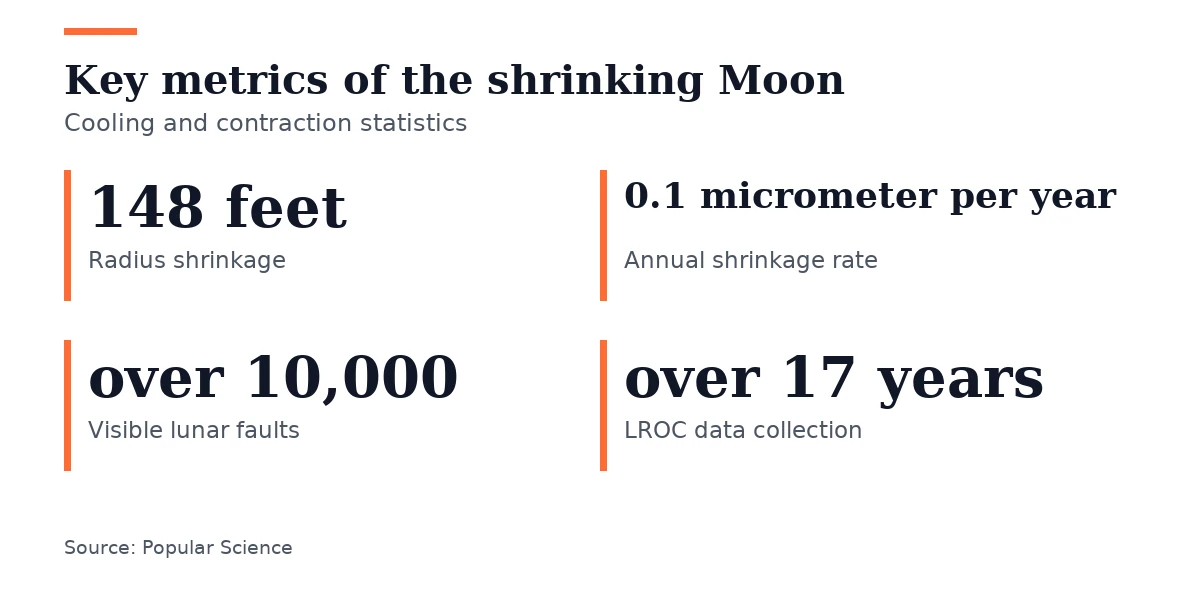
On Oct. 14, 2026, Popular Science said the Moon’s radius shrank by almost 148 feet during the past 400 to 800 million years while the body continues to cool.
Researchers used data from NASA’s Lunar Reconnaissance Orbiter Camera (LROC), which has collected over 17 years of millions of lunar surface images. Analysis of LROC imagery revealed over 10,000 visible lunar faults (cracks in the Moon’s crust).
Planetary geologist Thomas Watters said the number of young faults seen in LROC images far exceeded his expectations. He added that as the Moon’s interior continues to cool and contract, scientists expect existing faults to grow, and scientists expect new faults to form.
Since the Moon possesses a single shell-like plate rather than Earth’s tectonic plates, its interior cooling can cause slips and faults to appear anywhere across the lunar surface at any time. On Earth, roughly 90 percent of seismic activity occurs near lithospheric plate boundaries.
Areas of the Moon that have the thickest crust show fewer faults, indicating they could be more stable than regions with thinner crust. Knowing how moonquakes distribute and how often they occur would help NASA plan for a long‑term human presence on the Moon.




Join the discussion