Key facts
- Observations were made with Webb's NIRSpec instrument, recording the object's spectrum every 15 minutes for approximately 11 hours.
- Dr. Mark Marley of the University of Arizona explained that photons passing through the atmosphere and escaping to space are analogous to viewing the world through a screen door that filters some light.
- Comparison of the observed spectra with atmospheric models showed that water clouds are required to reproduce the overall shape of WISE 0855's spectrum.
- The best‑fitting model includes a cloudy atmosphere with chemical mixing, indicating that water clouds vary in thickness while deep gases rise and fall.
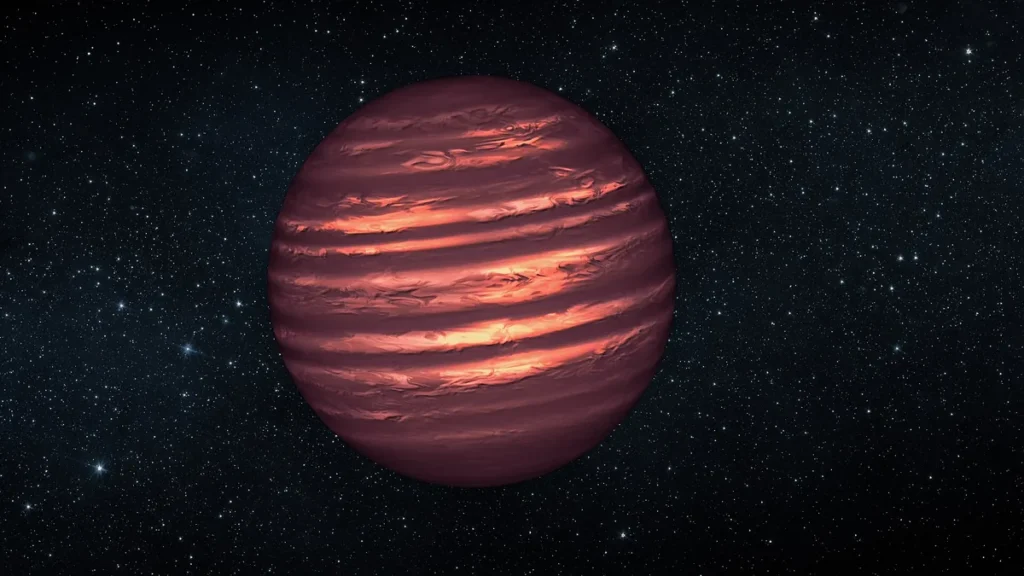
On Oct. 9, 2026, astronomers using the James Webb Space Telescope obtained the first time‑resolved medium‑resolution spectra of the ultracool brown dwarf WISE J085510.83-071442.5, located 7.4 light‑years from Earth. The object’s temperature is about 265 kelvin (‑8 °C, 17 °F), cool enough for water clouds to form high in its atmosphere yet warm enough to keep ammonia from condensing. These conditions set the stage for detecting time‑variable cloud structures in a solitary substellar object.
WISE 0855 has roughly twice the mass of Jupiter but a diameter nearly identical to Jupiter’s, giving it a surface gravity similar to that of a giant planet. Observations were carried out with Webb’s NIRSpec spectrograph, which recorded the object’s spectrum every 15 minutes for approximately 11 hours, producing a time‑resolved data set. Because the measurements are spectra rather than simple photometry, researchers could isolate the molecular signatures responsible for the observed brightness changes.
Comparing the observed spectra to atmospheric models showed that water clouds are required to reproduce the overall shape of WISE 0855’s spectrum. Dr. Mark Marley of the University of Arizona explained that photons passing through the atmosphere and escaping to space are analogous to viewing the world through a screen door that filters some light. The best‐fitting model includes a cloudy atmosphere in which chemical mixing allows water‐cloud thickness to vary while deep gases rise and fall.
Model comparisons also indicated that patchy water clouds exist and that their thickness changes over time, with carbon monoxide and phosphine variations originating in deeper high‐pressure layers while cloud‐thickness changes occur in the upper low‐pressure layers.
Dr. Brittany Miles, a postdoctoral researcher at Steward Observatory, reported that the data reveal water clouds getting thicker and thinner and deep gases rising and falling, with these changes visible in real time across the 11‑hour monitoring window. She noted that this is the first time researchers have been able to confirm that water‑cloud thickness varies over time on an object outside the Solar System. Variations in carbon monoxide absorption reached up to 10 percent between peaks at certain wavelengths, and the phosphine signal mirrored the carbon monoxide variations.

The detected atmospheric dynamics on WISE 0855 resemble weather patterns seen on Jupiter, suggesting that the same basic physics of convection, clouds and chemistry govern both objects despite their different masses and the brown dwarf’s isolation. Dr. Brittany Miles added that if the underlying physics is universal, it applies to the gas‑giant exoplanets that astronomers are now studying in detail with JWST. This similarity offers a direct analogue to the weather‑monitoring techniques used for Jupiter and other giant planets.
Observations of the cold exoplanet Epsilon Indi Ab show a temperature estimate ranging from 200 to 300 kelvin and a mass of 7.6 Jupiter masses, with a diameter similar to Jupiter’s. Spectroscopic data for Epsilon Indi Ab revealed a weaker‑than‑expected ammonia absorption feature, which researchers attribute to thick, patchy water‑ice clouds in the atmosphere. Atmospheric models that include very optically thick water‑ice clouds fit the Webb photometric points of Epsilon Indi Ab and explain its faintness at 3‑5 micrometer wavelengths.
The presence of water‑ice clouds on Epsilon Indi Ab helps account for the discrepancy between simple cloud‑free model predictions and the observed ammonia signal, indicating that clouds can mask chemical signatures in cold atmospheres. Elisabeth Matthews of the Max Planck Institute for Astronomy stated that JWST finally enables detailed study of solar‑system analogue planets, allowing astronomers to examine Jupiter‑like worlds in depth. The similarities between the shallow ammonia feature of WISE 0855 and that of Epsilon Indi Ab suggest that cold atmospheres may commonly exhibit cloud‑related spectral effects, implying that many model assumptions need revision.
Researchers noted that future JWST photometry and spectroscopy from 3 to 20 micrometers will test the existence of water‑ice clouds on cold worlds and clarify why ammonia features appear weaker than predicted. Together, the WISE 0855 and Epsilon Indi Ab results demonstrate that time‑resolved spectroscopy can reveal evolving cloud structures on ultracool objects, providing a direct analogue to the weather‑monitoring techniques used for Jupiter and other giant planets.


Join the discussion