Key facts
- Five faint flashes were observed on the Moon's far side during a planned communications blackout.
- NASA released over 800 GB of Artemis II mission data to the public, making available more than 11,000 photos and videos and roughly 8.5 hours of audio.
- Artemis II launched on April 1, 2026, carrying Reid Wiseman, Victor Glover, Christina Koch and Jeremy Hansen aboard Orion.
The Economic Times reported that NASA had released over 800 GB of Artemis II mission data to the public. NASA’s release includes over 11,000 full‑resolution moon pictures and video clips taken with handheld gear and cameras on Orion, along with about 8.5 hours of audio where astronauts logged scientific notes and added their own marks.
The agency placed the material in its Planetary Data System (NASA’s archive for planetary mission data) and issued three companion guides—the Preliminary Lunar Science Report, the Lunar Science Operations Report and the Lunar Science Data User Guide—to help researchers use the collection. NASA states that the images, sound recordings and crew‑marked photos add to the decades of data gathered by Apollo astronauts and robotic probes, and the material is already shaping plans for Artemis III and future flights.
NASA also calls the set the first planetary science dataset chiefly collected by humans in over 50 years, and points out that portions of it have never been publicly available. Artemis II lifted off on Apr. 1, 2026 with Reid Wiseman, Victor Glover, Christina Koch and Jeremy Hansen aboard Orion, and the crew returned to Earth on Apr. 10. Over the seven‑hour window when the crew observed the Moon, they relayed their visual descriptions to mission controllers on Earth.
While on the far side during a planned communications blackout they reported five faint bursts, and Orion was about 46,000 miles from the Moon at that moment. The crew saw the lunar surface in shades of gray, black, brown, tan, white, green and blue, and noted variations in color and brightness across the terrain.
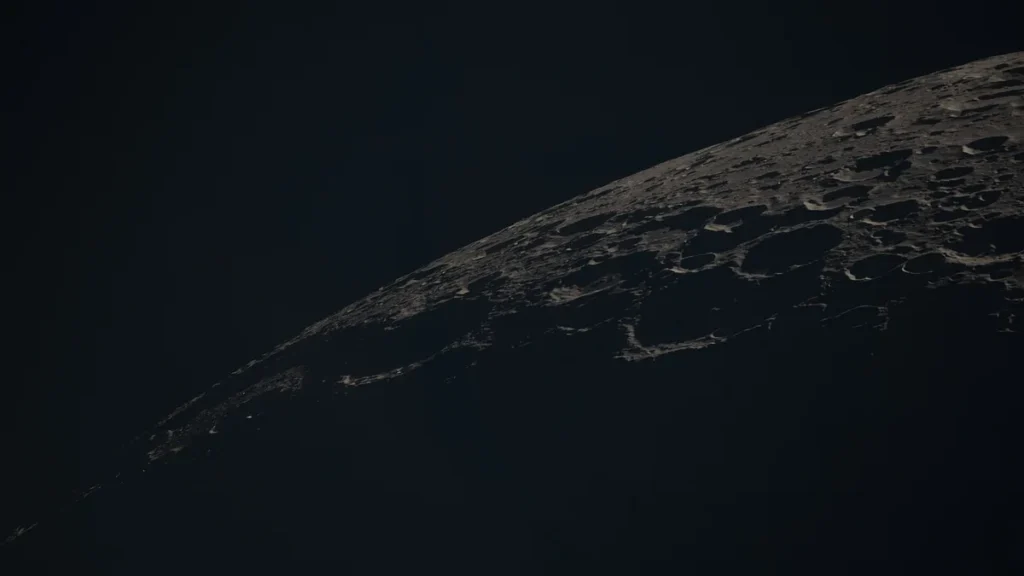
Close to the lunar terminator (the line dividing day and night on the Moon), sunlight hits the ground at a shallow angle, casting long shadows that make crater outlines and depth stand out. During the rough hour‑long total solar eclipse on the far side, the darkness let astronauts spot the faint impact flashes, and because the Moon lacks an atmosphere, incoming objects strike the surface without slowing.
The crew’s direct observations of impact flashes on the far side give a rare dataset for assessing how often such small impacts occur, which helps evaluate risks to future lunar habitats; blue hues point to titanium‑rich volcanic rocks, browns reflect varying iron content, greens indicate glass formed by eruptions or impacts, and these color differences may help future explorers locate potential resources such as ilmenite (a titanium‑iron oxide mineral).
Scientists can compare the crew’s color and brightness notes with Lunar Reconnaissance Orbiter readings to check orbital data. Because how colors look shifts with the Sun’s angle, astronauts learned to judge lighting effects—a skill needed for polar Artemis landings where extreme light alters perception—and they were taught to separate illumination tricks from real rock features for safe travel, clear records and sound analysis.
The lunar terminator gave the crew some of the clearest looks at the Moon. Scientists asked them to examine this zone because its lighting mimics that of the Moon’s South Pole. With strong topographic light and no air to blur the view, astronauts could discern crater shapes, mountain textures and surface details sharply. As the terminator swept across, shifting light and dark revealed terrain in flashes.

During the eclipse, deep craters and tall peaks stood out along the Moon’s lit edge, backlit by the Sun. These insights will guide future Artemis missions in picking cameras, aiming them and deciding the required detail level.
Earth’s terminator appears fuzzier than the Moon’s because our air spreads sunlight, smoothing the shift from day to night. From Orion’s view the crew saw the Sun vanish behind the Moon and stay hidden for 54 minutes; the Moon’s large, almost motionless disk blocked sunlight far longer than a typical Earth eclipse, letting astronauts study normally hidden phenomena such as impact flashes, Mars, Saturn, galaxies, stars and the faint zodiacal light from interplanetary dust (a faint glow of sunlight scattered by dust in the solar system).
The eclipse also presented the crew with a rare look at the Sun’s faint outer layer, the corona (the Sun’s outer atmosphere). While scientists still puzzle over why the corona runs millions of degrees hotter than the solar surface and how it speeds plasma outward, the astronauts’ direct view let them collect data on space‑weather effects that could affect spacecraft hardware and crew safety.
A picture of Earth taken from roughly 6,000 miles away displayed detailed layers of the planet’s natural systems, even though it looks sunlit, it was actually shot by moonlight on flight day two, giving a rare full‑disk night view. After the image reached the ground, researchers spotted active weather systems, auroras at both poles, distinct atmospheric layers, a large Saharan dust plume moving west and a glowing zodiacal‑light cone that ends at Earth’s limb with Venus marking its tip.
A zoomed‑in portion reveals lightning flashes over the Congo basin, and city lights are visible across northern Africa and the Iberian peninsula, indicating human activity. Christina Koch described the Moon as a light sponge and Earth as a light mirror, noting that the deep royal blue of oceans was not visible and the continents appeared as a dark bluish‑green against an electric‑blue backdrop; the crew reacted to an Earthrise with the remark, “The Earth is smiling at us!”
NASA frames the mission as a relay race, explaining that the Artemis II crew drew on decades of information from past human and robotic explorers and that their findings now lay groundwork for today’s and tomorrow’s scientists. This release continues a long chain of data hand‑offs, and because it bundles pictures, sound, crew notes and observations, it offers a context that no single datum can supply alone.
Artemis II also served as a test of how NASA weaves science into a contemporary crewed lunar flight, using fresh science operations teams, new facilities, updated training methods and revised flight‑controller procedures. A number of international partners launched CubeSats on the mission, with agencies Germany, South Korea, Saudi Arabia and Argentina placing their small satellites (miniature satellites) in high Earth orbit on Apr. 1, 2026 after the launch vehicle cleared a safe distance from the crewed capsule.
Researchers can obtain the files through NASA’s Planetary Data System, where the Data User Guide provides step‑by‑step instructions for accessing the images, video, audio and annotation files.



Join the discussion